

Rare FNIP1 mutations and cardiometabolic protection
What if certain people were born with a metabolic configuration that kept fat out of the liver and bloodstream, reduced blood sugar, and prevented type 2 diabetes?
Such a trait could spare them from numerous health complications.
A Nature study involving more than one million people from three continents has identified rare mutations in a single gene that seem to provide striking protection from diabetes, heart disease, and other cardiometabolic conditions.
Cardiometabolic diseases are the world's leading cause of death, accounting for roughly 1 in every 3 deaths in the US.
Researchers uncovered the gene, known as FNIP1, while searching for genetic variants associated with the ratio of triglycerides (TG) to high-density lipoprotein (HDL) cholesterol.
"The higher this ratio is, the higher the risk of metabolic disease," says Luca Lotta, a geneticist at Regeneron Pharmaceuticals who co-led the research.
How FNIP1 mutations alter energy use
These particular FNIP1 mutations are uncommon: about 1 person in every 7,000 in the study carried one of the variants.
Just 155 participants had these "protein-truncating" mutations, yet their metabolic differences were pronounced. As a group, they had approximately 60 percent lower odds of developing cardiometabolic diseases.
The FNIP1 gene encodes folliculin-interacting protein 1. Under normal circumstances, it works alongside another protein, folliculin, to restrain cellular energy expenditure, enabling the body to retain energy.
This pathway helps control mitochondria, the energy-producing structures within cells, and the systems responsible for breaking down and recycling cellular components.
Partially disabling FNIP1, which results in a faulty protein, seems to remove that restraint, causing the body to use up energy.
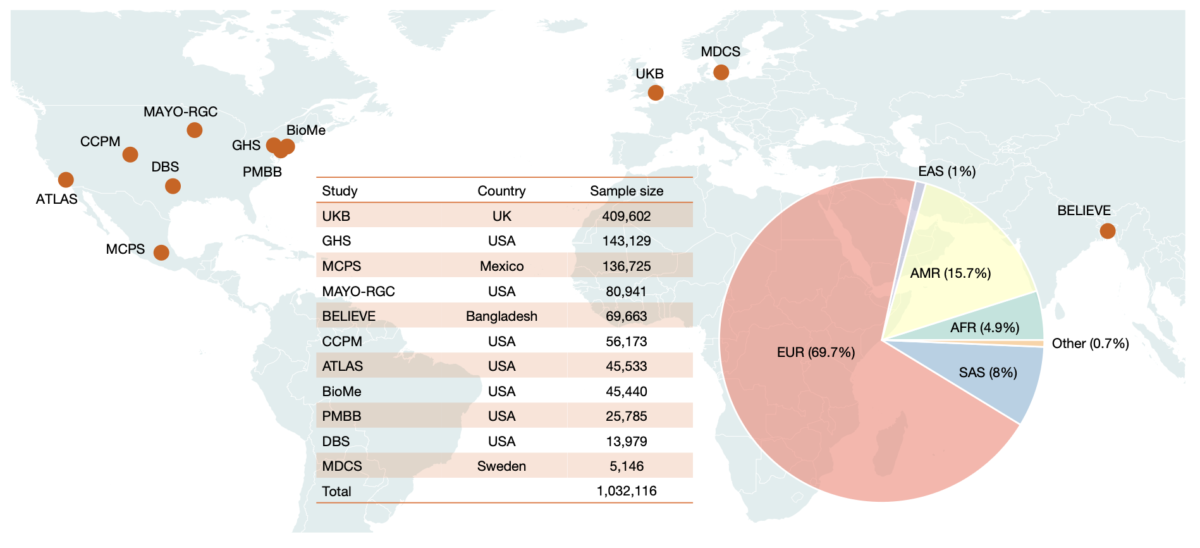
The study authors combined databases from several countries to create a sample of more than one million people, allowing them to analyse rare variants in relation to the TG:HDL ratio. (Hindy et al., Nature, 2026)
"These individuals consume, store, and utilize energy more than individuals without those mutations, and that's the protective factor," says Lotta.
Laboratory work also provided evidence supporting this mechanism.
In human liver cells, silencing FNIP1 activated genes involved in fat burning. In mice, altering a comparable pathway shielded animals on a high-fat, high-fructose diet from gaining fat, while enhancing insulin sensitivity and lowering both liver fat and liver damage.
Fat distribution and sex-specific genetic effects
Notably, the gene variant also seems to influence the location where body fat is stored.
Studies indicate that fat distribution affects cardiometabolic health: visceral fat, generally found around the organs and in the midsection, is more harmful than subcutaneous fat deposited in the buttocks, hips, and thighs. The healthier fat distribution seen in people with the variant may be central to their improved health outcomes.
The findings also included a compelling sex-specific detail.
As well as focusing on FNIP1, the team identified 58 other related genes. For most of them, the effects were strikingly alike in men and women.
However, rare variants in the PDE3B gene were more strongly linked to a favourable TG:HDL ratio in women than in men. This is particularly noteworthy because PDE3B has already been connected with fat distribution.

The researchers say that the metabolic profile produced by disrupting FNIP1 resembles, in some respects, the effects of GLP-1 drugs, which have transformed obesity and type 2 diabetes treatment in recent years.
There is, however, a significant difference: GLP-1 drugs work chiefly through hormonal signalling, whereas FNIP1 seems to affect the body's core machinery that determines whether energy is burned or stored.
According to the pharmaceutical company that led the study, this makes FNIP1 a possible drug target – though the word "possible" may be carrying considerable weight.
Evolution could account for the rarity of this mutation. Across most of human history, a body that efficiently conserved calories would have offered an advantage. In today's setting, where calorie-dense foods are plentiful, that same metabolic efficiency may be less beneficial.
"Nowadays, we are living in a very calorie-rich environment, and historically there's no precedent for this," Lotta says.
Related: Where You Carry Your Body Fat Is Directly Linked to Brain Ageing in First-of-Its-Kind Study
The limits of targeting FNIP1
Before anyone begins searching for an FNIP1-blocking tablet, one important question must be answered: what precisely occurs when this metabolic brake is deliberately switched off?
It remains unknown whether safely disabling FNIP1 with a drug could recreate the benefits observed in people who naturally carry these mutations. The researchers point out that completely disrupting the pathway can lead to serious problems.
The work offers another illustration of human genetics' ability to show what happens when nature inadvertently turns off part of our biology. Rare mutations can reveal biological pathways that researchers may wish to target.
These incredibly rare mutations, which might have been unfavorable for many millennia, are now favorable to the body," says Lotta.
This research was published in Nature.
This article was fact-checked and edited by Rebecca Dyer. Although we take pride in our process, we are only human. If you notice an error, please let us know.






Comments
No comments yet. Be the first to comment!
Leave a Comment