
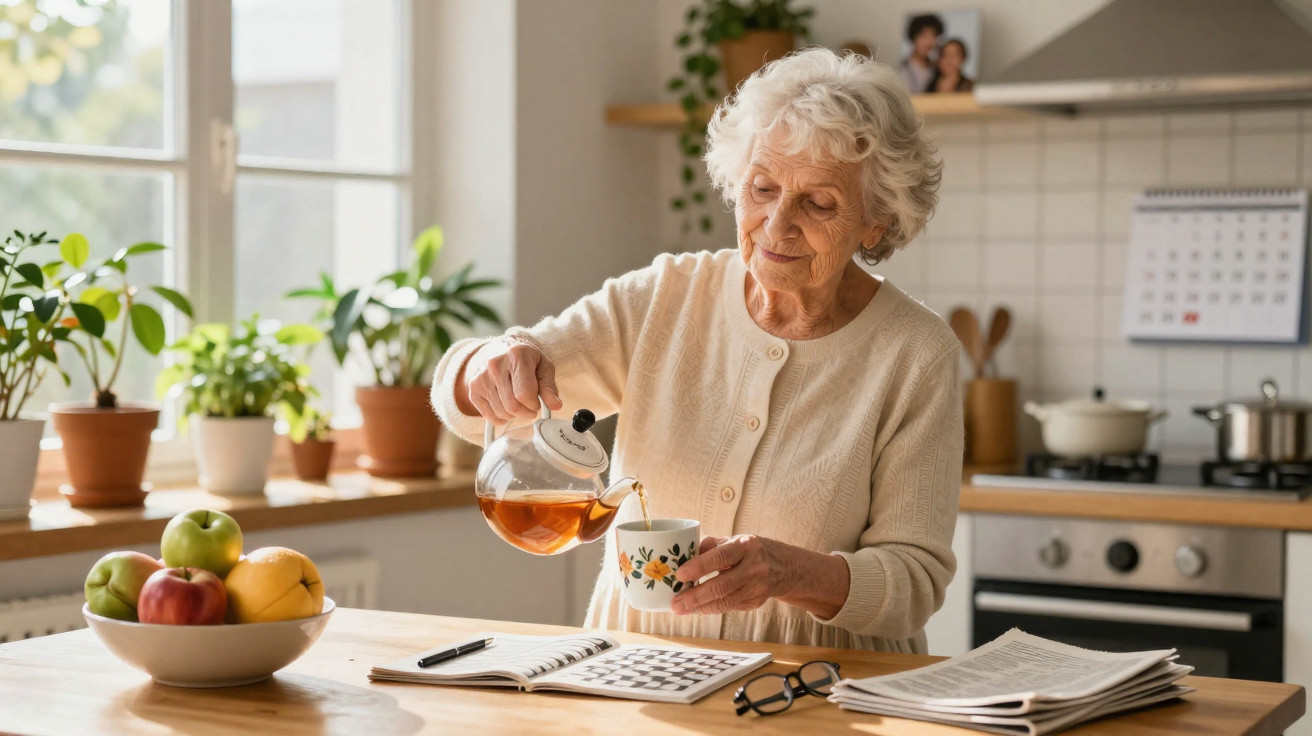
At precisely 10 a.m., a small terraced house on a peaceful English street begins to stir. The kettle whistles, while an old swing number crackles from the kitchen radio. Dressed in a pale blue cardigan, Margaret, aged 100, laces up her walking shoes as though she were off to work rather than living through her “twilight years”.
She chooses to live by herself.
“Care homes?” she snorts as she puts her key in the front door. “That’s how you ruin old age, dear.”
She goes outside, secures the door behind her and makes her way along the pavement, her shopping trolley clattering at her side. There is no carer supervising her and no timetable pinned to the wall. There is simply a woman who has reached 100 and remains determined to select her own biscuits.
The point is that this uncompromising routine may be why she is still here.
“A care home would kill me faster than time”: why Margaret refuses to move
On the surface, Margaret’s day is unremarkable. She brews tea, clears the table and waters the stubborn plant on her windowsill that will not die.
But every action expresses one conviction: she has not finished making her own choices.
She gets up at 7, prompted not by staff at her bedroom door but by the particular way daylight reaches her curtains. Every day, she walks to the corner shop, even when she only needs milk and an orange.
Each Thursday, she does her washing herself, steadying herself against the counter while the machine turns. “If I can load my socks,” she says, “I’m not ready for a home.”
Nothing about it is dramatic. It is simply an older woman fiercely holding on to her right to be mildly inconvenient.
Her relatives have urged her to go “somewhere safe”. Friends have posted brochures showing cheerful residents playing bingo in immaculate lounges. Margaret regards them as if they were promotional leaflets for a different world.
“Care homes aren’t evil,” she admits. “They’re just not life. They’re waiting rooms.”
She has watched the same thing happen too many times. A neighbour enters after a fall, “just for rehab”, then, a year on, their life has narrowed to a chair, television and meals chosen three weeks ahead. Certainly, there is comfort and medical support.
Yet there is also a loss she will not accept: friction, choice and the modest danger of burning the toast.
Her position is not purely emotional. For years, researchers have observed what they call the “institutionalisation effect” among older people. Once routine choices are removed - when to eat breakfast, what to wear or when to leave the house - people can often lose physical strength, mental sharpness and motivation more quickly.
Margaret does not cite research papers; she recognises what happens. “Once you stop doing things,” she says, “your body believes you.”
To her, avoiding a care home is not an act of defiance. It is a strategy.
The daily habits that keep a 100-year-old out of a care home
There is nothing glamorous or fashionable about Margaret’s routine. No green juices appear, and no yoga mat is unrolled beside a sunny window.
Instead, her “system” consists of a succession of small, determined decisions running through each day.
Movement comes first, without exception. While waiting for the kettle to boil, she slowly marches on the spot before breakfast: fifteen, twenty or sometimes thirty steps, with one hand resting on the worktop.
“I’m telling my legs they still work,” she shrugs.
Once she has had tea, she cleans the kitchen worktop and does the washing-up, even if there is only one mug. Next comes what she calls her “daily job”: one shelf, one drawer or one patch of garden. It is not about achieving immaculate cleanliness, but about showing that she can still make a difference to the world around her.
She also follows a walking rule. Unless rain is lashing down, she goes to the shop or, at minimum, walks to the end of the road and returns. Her large red coat is there “so drivers can’t pretend they didn’t see me”.
There is no step counter and no app. She simply has a century’s worth of instinct telling her that bodies seize up when they remain seated for too long.
Mentally, she reads the newspaper each day with a pen in her hand, marking words she dislikes. Politicians’ names. Fresh expressions such as “silver economy”. She fills in the crossword using large, unsteady handwriting, then rings her neighbour to debate the answers.
It is not a worthy routine. It is mischief, and it keeps her mind irritated and alert.
Many people assume that being independent at 100 requires remarkable discipline. Margaret’s secret is more ordinary than that: she has shaped her day around things she enjoys enough to keep doing.
She likes the gossip at the shop counter, so the walk there is pleasure rather than rehabilitation. She cherishes her late husband’s rosebush, meaning that pruning it is not “gardening exercise” but a visit with an old friend.
This is where many well-meaning families go wrong. They impose sterile, “healthy” routines that older people never enjoyed in the first place, and then feel guilty when those routines collapse. Let us be honest: nobody really does that every day.
Margaret has also arranged her life to allow her to be old while remaining free. Her GP visits her at home when necessary, a neighbour keeps a spare key, and the postman knows to knock loudly.
This is not careless independence. It is imperfect, negotiated autonomy - the sort of arrangement adults of every age genuinely live with.
She has had two falls over the past five years, though she conceals how frightened they made her. But if you suggest that the falls indicate she ought to enter residential care, she reacts sharply.
“Falling once doesn’t mean you belong in a home,” she says. “Falling and never getting the chance to walk again? That’s what frightens me.”
Her routines are small anchors against that anxiety: tea in her favourite mug, the same compact armchair by the window rather than a hospital-grade recliner, and her own mismatched spoons clinking in her own drawer.
They may seem insignificant. At 100, they are not.
- She picks her own meals, even when the choice is only soup and bread.
- She chooses when the curtains are opened and when they are shut.
- She holds on to one “ridiculous” ambition: to outlive the King.
Every one of these choices is a thread connecting her to herself. In her view, sever enough of them and old age truly begins to feel like waiting for the end.
What her story quietly asks the rest of us
Seeing Margaret slowly push her trolley towards the shop, it is easy to notice only vulnerability: the measured steps and the light coat on a blustery day.
Watch for longer, though, and another quality becomes clear: purpose.
Her life is neither efficient nor “optimised”, and it is not without risk. She spills tea, misplaces the gas bill and frequently complains about her legs. Still, every minor effort is a vote for another ordinary day in her own home.
One afternoon on a bus, a teenager offered her his seat. She accepted it, before telling him: “I’m not brave, love. I’m just vain. I like my own curtains.”
Most of us know the moment of entering an older relative’s house and recognising their particular smell: history mixed with a type of disorder that would never meet a care home inspection. That scent is belonging, too.
Her experience does not cast care homes as villains. Many offer genuine safety and refuge. For certain people, they are quite literally the difference between neglect and survival.
But Margaret poses a less comfortable question: do we sometimes surrender control too readily in exchange for convenience, both for ourselves and for older relatives?
Care homes may offer clinical oversight, group activities and respite for exhausted families. They can also smooth out individuality: identical meals, matching routines and the same beige carpets.
Margaret’s refusal exposes that compromise starkly. Could “safety” that eliminates every point of friction also speed up the decline we are trying to prevent?
Could the real luxury of old age be not a pristine shared lounge, but being able to decide that today you will have biscuits for dinner and turn in at 11?
Her daily habits are not a template for everyone. They are an invitation to ask older people what they actually want, rather than what reduces our own anxiety. They urge us to preserve opportunities for them to do one small task themselves, even if it takes longer, looks messier or carries more risk than it would in professional hands.
They also require us to acknowledge an untidy truth: keeping someone out of a care home takes effort from everybody nearby - neighbours, family members, health professionals and even the postman who knocks twice.
Perhaps that is why Margaret’s story remains with you after leaving her little house and heading back along her street. It is not only about an obstinate centenarian who dislikes care homes. It concerns how each of us hopes to live when our hands tremble and our knees hurt.
Her habits express what many of us hesitate to say: we would prefer a little disorder to giving up the right to decide when to make our own tea.
At 30, 60 or 95, the question she raises is identical: when that time arrives, would you choose maximum safety, or one more morning in which you choose your own biscuits?
| Key point | Detail | Why it matters to the reader |
|---|---|---|
| Micro-habits over “magic” secrets | Margaret depends on straightforward daily actions - walking, light household tasks and mental games - rather than extreme health hacks. | Shows that realistic changes can extend independence, even very late in life. |
| Autonomy versus institutional comfort | She regards care homes as safe but restrictive, and works to preserve genuine everyday choice. | Helps readers consider the compromises involved for relatives - or for themselves in later life. |
| Shared responsibility for independence | Her independence receives quiet support from neighbours, doctors and the community around her local shop. | Encourages readers to imagine a practical support network for older people beyond the simple “home or institution” debate. |
FAQ:
- Is it really safe for a 100-year-old to live alone? There is always an element of risk, but safety involves more than alarms and four walls. With medical monitoring, neighbours dropping in and a home adjusted to suit their abilities, some centenarians can sustain a degree of independence that works for them.
- Do care homes actually shorten people’s lives? Research offers no straightforward yes-or-no answer. Some residents flourish with suitable support, while others deteriorate more quickly after losing autonomy and familiar routines. The crucial factor appears to be whether people retain a sense of control over anything.
- What habits really help older people stay independent? Frequent gentle activity, meaningful responsibilities rather than mere “busywork”, social interaction and modest daily choices - what to eat, wear and when to go out - all appear to slow decline more effectively than occasional major efforts.
- How can families support an elder who refuses a care home? Begin by hearing what worries them most. Then create a safety net that respects their preferences: home visits, fall prevention measures, neighbours with spare keys, technology they can genuinely use and adaptable assistance rather than a complete takeover.
- When does a move to a care home become unavoidable? It is usually when essential needs cannot be met at home, even with support: recurrent dangerous falls, unmanaged health problems, severe cognitive decline or carer exhaustion so profound that everyone’s wellbeing is threatened.

Comments
No comments yet. Be the first to comment!
Leave a Comment