
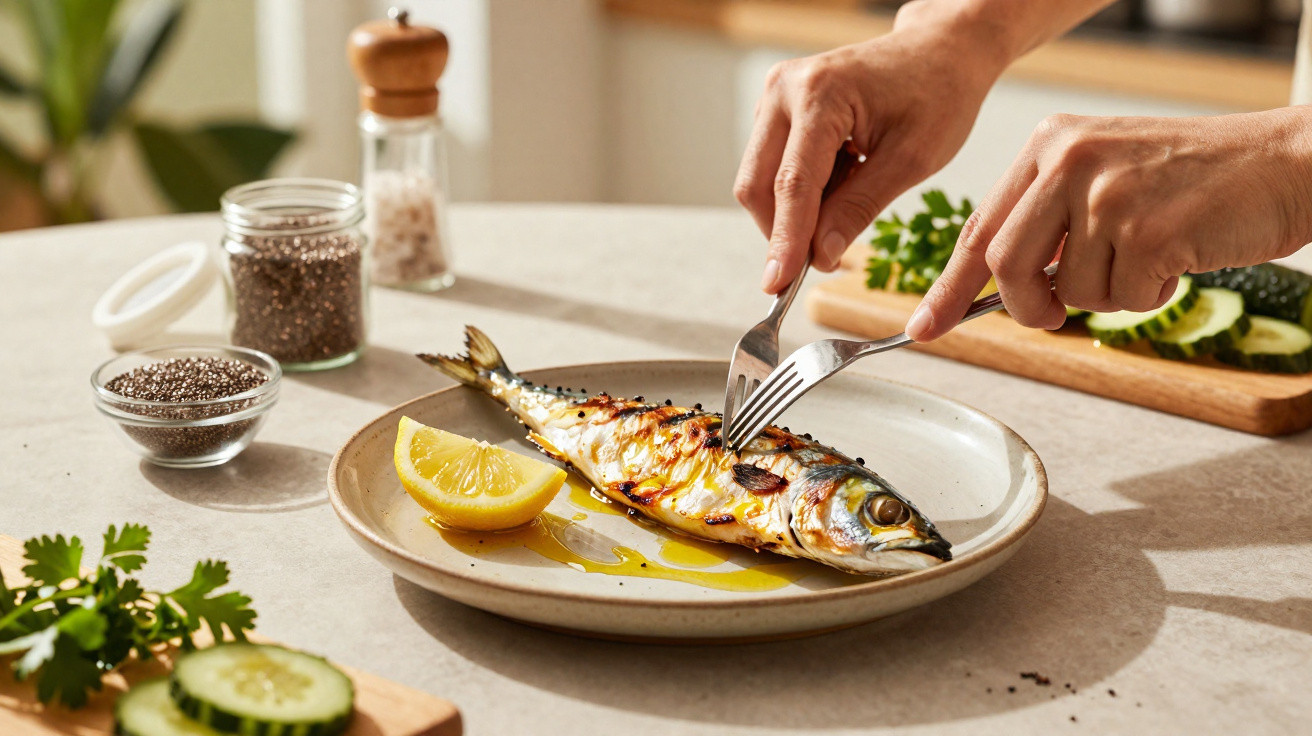
The waiter had scarcely finished describing the catch of the day when the couple at the neighbouring table interrupted him: “Salmon, please. Extra omega-3, you know.” He gave a courteous smile, yet glanced towards the kitchen, where a different fillet was gently frying, glossy with oil and carrying a fuller, more savoury aroma than healthy eating’s familiar pink star.
Nobody ordered it by name. Few realised that this unassuming dark-fleshed fish was the menu’s true omega-3 powerhouse - and, unexpectedly, a natural source of collagen as well.
Somewhere amid nutrition misconceptions and polished wellness content, this understated contender was forgotten.
Harvard scientists have not forgotten it.
Meet the real omega-3 and collagen heavyweight
The fish quietly outperforming both tuna and salmon on the nutrition scorecard is mackerel.
This is not merely the tinned option people overlook in the supermarket aisle. It is an oily cold-water fish that Harvard nutrition specialists repeatedly place among foods worth eating more regularly.
Rich and oily, with dark flesh and a pronounced character, it could hardly be more different from the mild, social-media-ready fillet many of us choose without thinking.
Harvard’s School of Public Health frequently identifies oily fish such as mackerel as among the densest sources of the marine omega-3 fatty acids EPA and DHA.
For every 100 grams, Atlantic mackerel can provide almost double the omega-3 content of farmed salmon, supplying roughly 2 to 3 grams of these “long-chain” fats in a modest serving. Its skin and connective tissue also contain collagen and collagen-forming amino acids, which support the body’s own collagen production.
Think about the last time you were standing at the fish counter. You probably noticed neatly cut orange salmon portions, tuna steaks displayed like cuts of meat and, off to one side, shorter striped fillets that were darker, cheaper and less photogenic.
Those were probably mackerel: a fish valued for generations in cuisines from Portugal to Japan, even as many modern Western consumers passed it by in favour of labels such as “premium salmon” and “sashimi-grade tuna”.
Why mackerel beats tuna and salmon where it matters
Tuna appears impressive on paper: it is lean, protein-rich and familiar. However, most cuts of tuna contain comparatively little omega-3 beside oily fish, particularly canned varieties packed in brine.
Salmon performs better, although the omega-3 level in farmed salmon can vary considerably according to feed, origin and farming methods - a point repeatedly highlighted by nutrition research from Harvard and other institutions.
Mackerel, particularly Atlantic mackerel and certain cold-water species, is generally dependably high in omega-3. It naturally feeds on plankton and smaller fish, retaining polyunsaturated fats in its flesh and skin.
Ironically, the elements that some people find “too strong” in flavour are precisely the areas with the greatest concentration of omega-3 and collagen-related nutrients.
Its nutritional value extends beyond omega-3. Mackerel also provides vitamin D, vitamin B12, selenium and protein, all of which help the body produce and preserve collagen.
Collagen is not solely connected with skin: it also matters for joints, tendons, the gut lining and even the walls of blood vessels. A fish that provides omega-3s to help reduce inflammation alongside the materials needed for collagen therefore offers a two-fold contribution to long-term health.
How to actually eat more mackerel without hating it
Mackerel’s challenge is seldom its nutritional profile; it is its image. Some people recall an unpleasant school dinner or a fillet that was overcooked and overly pungent.
A simple way to change that is to begin modestly: make one mackerel meal each week, cooking it quickly over high heat so that the flesh remains moist and the smell does not fill the house.
Mackerel fillets grilled skin-side on, brushed with olive oil, lemon, garlic and a little salt, take under 10 minutes beneath a hot grill. The skin becomes crisp, rather like chicken skin, and that is exactly where the collagen-linked proteins and omega-3 fats are most concentrated.
Serve it with potatoes or a green salad, or fold it into a warm tortilla with cabbage and yoghurt sauce, and it becomes less of a “health move” and more like a street-food find.
For anyone nervous about preparing fresh fish, tinned mackerel in olive oil is a particularly overlooked option. Flake it through pasta, mash it with mustard and herbs for a speedy spread, or stir it into a warm bowl of rice with soy sauce and spring onions.
On an exhausted Tuesday evening, it can be the difference between making something satisfying and ordering ultra-processed food that leaves you feeling heavy and unfulfilled.
We have all opened the fridge, spotted a solitary tin of fish and thought, “I’ll just eat something else.” With mackerel, that tin is actually a small wellness shortcut wrapped in metal, rather than a leftover option from 1998.
Let’s be honest: nobody really does this every day, weighing their omega-3 intake or reading Harvard studies before dinner. What we do tend to choose is whatever is convenient and comforting.
There is also a wider issue often obscured by recipe images and macronutrient counts: the way food decisions affect both the environment and household budgets.
- Mackerel is usually less expensive per kilogram than premium salmon or tuna.
- Many mackerel populations, particularly in the North Atlantic, have historically been more sustainable when properly managed.
- As a smaller, shorter-lived fish, mackerel generally accumulates fewer contaminants than certain large predatory fish.
What this quiet fish is really saying about our health habits
Mackerel is more than “the fish with the most omega-3 and collagen potential on your plate”. It is almost a reflection of contemporary eating habits: we pursue famous names, attractive colours and the reassurance of ordering what everyone else chooses, while less celebrated foods can offer concentrated, science-supported advantages in plain sight.
There is something faintly rebellious, and almost traditional, about restoring a strongly flavoured, dark-fleshed fish to the middle of the table.
Harvard’s underlying message is not really about one miraculous fish, but about an overall eating pattern. Bringing oily fish such as mackerel back once or twice weekly gives the body a steady, dependable supply of marine omega-3s and collagen-related nutrients.
You do not need neon-labelled powders or miracle capsules to begin supporting your joints, heart, skin and brain against the gradual pressures of modern life.
Perhaps the meaningful change begins with something seemingly minor: choosing that “other” fish on the menu. Try it once, then try it again, prepared a little more carefully and seasoned a little more boldly.
Share the discovery with somebody who still believes tuna is the ultimate healthy fish. The mackerel story is about how we can subtly and gently reshape our plates - and, over time, a significant part of our future health.
| Key point | Detail | Benefit for the reader |
|---|---|---|
| Mackerel beats salmon and tuna in omega-3 | Atlantic mackerel often contains 2–3 g of EPA/DHA per 100 g, more than many farmed salmon and far more than most tuna cuts | Choose the fish that delivers the strongest heart, brain and anti-inflammatory benefits per serving |
| Natural collagen and collagen-supporting nutrients | Skin and connective tissue provide collagen and amino acids such as glycine and proline, alongside vitamin D and protein | Support skin elasticity, joints and tissues without depending solely on supplements |
| Easy ways to eat mackerel weekly | Grilled fresh fillets, tinned mackerel in olive oil, tacos, salads and spreads | Make nutrient-dense food into practical, flavourful meals suited to busy everyday routines |
FAQ:
Is mackerel really healthier than salmon?
Not in every respect, but it frequently provides more omega-3 per gram, especially Atlantic mackerel, whereas salmon may offer slightly more vitamin A and a milder flavour. Both are excellent choices; variety matters most.What type of mackerel should I choose?
Choose Atlantic or “European” mackerel from well-managed fisheries, either fresh or tinned in olive oil or water. If you are monitoring salt or processed meat consumption, avoid heavily smoked products.Does cooking destroy omega-3 and collagen?
Prolonged high heat may reduce some omega-3s and damage proteins, so opt for rapid cooking methods: grilling, pan-searing, baking at a moderate temperature or gently reheating tinned fish.Can I replace collagen supplements with mackerel?
Mackerel supplies collagen and amino acids that support the body in producing more, but it will not work exactly like a high-dose collagen powder. Consider it a potent natural foundation rather than a pharmaceutical product.How often should I eat mackerel for benefits?
Many heart-health and nutrition specialists, including guidance associated with Harvard, recommend two portions of oily fish each week. Mackerel can make up one or both portions, alongside other fish you enjoy.





Comments
No comments yet. Be the first to comment!
Leave a Comment