
Helga, 74, sits at the table with both hands wrapped around a hot mug. “I used to spring up without thinking,” she says with a brief laugh, “but now I need a bit of momentum first.” Her eyes move from her slippers to the small rug in the living room, where a new habit has emerged over the past few months: five minutes of stretching before the day begins. There is no yoga influencer and no extreme fitness challenge. Just a handful of straightforward movements that stop her knees from complaining quite so much and her shoulders from objecting whenever she reaches into the kitchen cupboard. It may look unremarkable, but it changes the mood of the whole day. It is a quiet reset for a body that has already been through a great deal.
Why people over 70 benefit from their own morning stretching routine
Anyone over 70 will recognise that particular resistance in the morning. It can feel as though someone has tightened every screw overnight. Those first steps from the bed to the bathroom are stiffer, slower and perhaps a little cautious. Yet the day can suddenly feel more manageable when the body has had the chance to say, “Hello, I’m awake,” before being asked to do anything demanding. This is where a morning stretching routine comes in. It is a friendly handshake between the mind and the joints: five to ten minutes that send the message, ‘Today, we work together rather than against each other.’
A geriatrician in Cologne told me about a 79-year-old patient, once a bricklayer and now retired, who was especially frustrated by his mornings. “It takes me half an hour just to get to the kitchen,” he complained. The practice suggested an exceptionally simple sequence: ankle circles while seated, straightening and bending the knees while sitting down, then stretching the calves against the kitchen worktop while standing. After four weeks, the half-hour had become 15 minutes. It was not a miracle or a rejuvenation treatment. It simply meant noticeably less uncertainty during those first few steps and the sense of regaining a small measure of control. That is when a routine can unexpectedly begin to feel like freedom.
There is a straightforward reality behind this. As we age, the body loses flexibility and muscle strength unless it is used regularly. Joint capsules become drier, muscles decline more quickly and fascia can become less mobile. Starting the day from zero to full speed forces a stiff body straight into everyday demands. A gentle stretching routine is more like gradually turning on a tap after winter. The movements lubricate the joints, encourage circulation and activate the deep muscles that help protect us from falls. It is not dramatic, but it is highly practical, especially after 70.
The easy 10-minute morning stretching routine: from bed to kitchen without a struggle
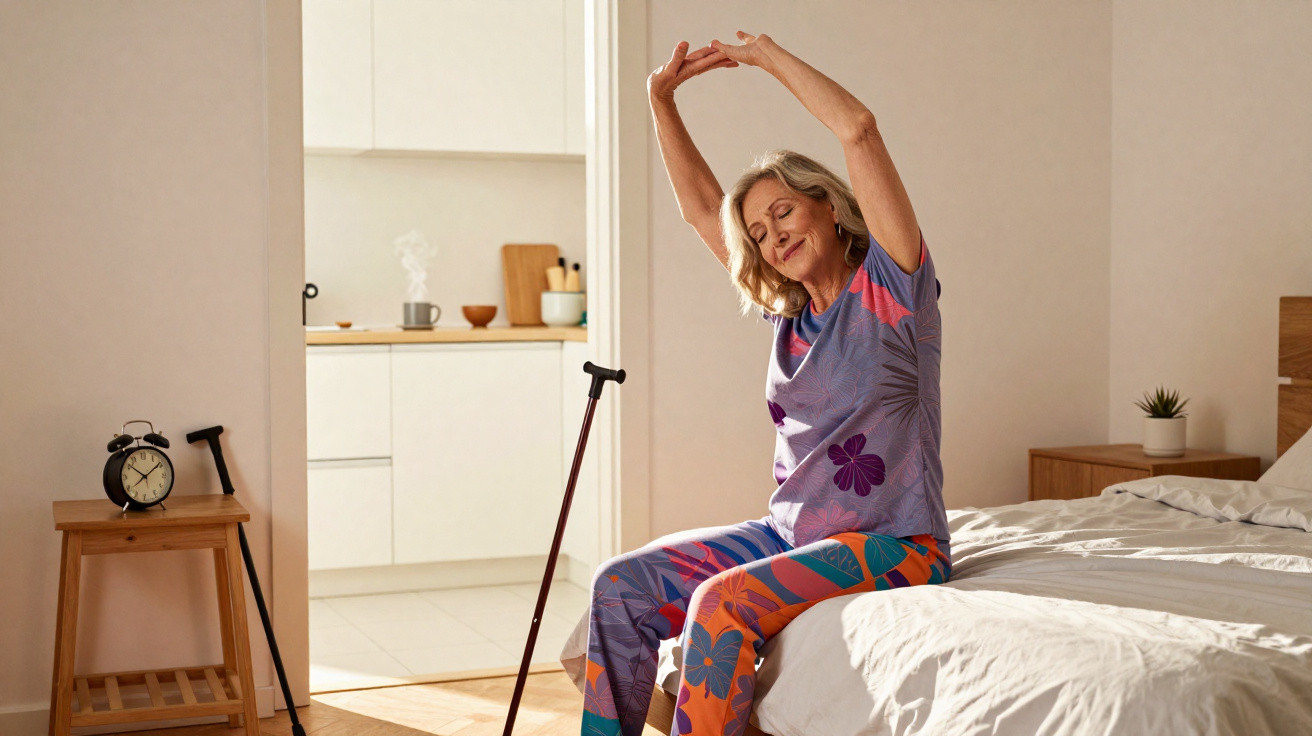
The best morning routine for people over 70 is not the most perfect one; it is the one they can actually do. Start where you already are: in bed or immediately beside it. First, while sitting on the edge of the bed, circle each foot 10–15 times, first outwards and then inwards, to wake up the ankles and calves. Second, straighten one leg at a time while seated, pull the toes towards you, hold briefly and place the foot back down. Third, stand with one hand on the bed frame or a chair and slowly raise and lower your heels, like a miniature calf press. Finally, while standing, lift your arms out to the sides and overhead as if reaching for a suitcase on a high shelf, then stretch gently. These four or five exercises take no longer altogether than making a cup of coffee.
The most common mistake is not ‘stretching too little’, but trying to do too much at once. Anyone who decides to work every muscle after years without exercise can quickly end up frustrated - or in pain. We all know that moment when good intentions become stronger than the body. A stretch that creates a pulling sensation is fine; one that stings or burns is a warning sign. Let us be honest: nobody will keep doing this every day if it feels like a test. A more helpful approach is to keep it small but consistent. Use a chair as reliable support, focus your eyes on a fixed point and breathe calmly. If you only manage two exercises on a particular morning, that is still better than setting off stiffly as usual.
A physiotherapist who has worked with older female patients for years put it this way recently:
“I always tell my over-70s: your morning routine is not an exercise programme. It is a polite greeting to your body. If you begin politely, the day is much less likely to shout back at you.”
- Start seated: Stretching on the edge of the bed or on a sturdy chair offers security, particularly if you feel dizzy or unsteady.
- Breathe slowly: Pair every stretch with a calm exhale. This eases inner tension and helps the muscle relax.
- Follow a set sequence: Use the same order each time so the body ‘recognises’ the routine and joins in more easily.
- Keep the duration realistic: 5–10 minutes is entirely enough; anything longer can be a bonus rather than an obligation.
- Make gentle adjustments: On good days, stretch a little further; on tired days, simply suggest the movement - without feeling guilty.
What this stretching routine can genuinely change in everyday life
When you speak to people who have tried this type of morning routine for a few weeks, similar comments come up again and again. “I trip over the rug less often.” “I’m not as frightened of the stairs in the morning.” “After getting up, I no longer need ten minutes to sort my back out.” It is rarely about dramatic before-and-after pictures. Instead, it is about tiny changes in daily life that feel subtle at first but seem enormous in hindsight. If getting moving in the morning becomes easier, people are more likely to go outside, walk to the bakery or get off the bus one stop earlier. Movement encourages more movement, even when it starts with ten ankle circles on the edge of the bed.
This kind of routine can also give the morning some structure. Days can easily blur together in retirement, particularly in winter when daylight arrives later. Five regular minutes of stretching act as a small anchor in the day. It is not an appointment that requires preparation, but a brief time when your own body takes centre stage. That may sound almost spiritual, but it is not. It is a practical way of saying: “I’m not starting from nothing today; I’m bringing my body along with me.” This attitude often brings a quiet wish to take slightly better care of yourself in other ways too - during breaks, while sitting and when standing for long periods.
Perhaps that is the quiet revolution of this seemingly simple stretching routine: it is not designed for exceptionally athletic older people, but for ordinary people over 70 who have become slower in the morning and do not simply want to accept it. There is no gym, no high-tech mat and no app that scolds you for missing a day. There are only a few repeated movements that remind the body it can do more than it believes immediately after waking. Anyone who treats these five to ten minutes in the diary as seriously as a doctor’s appointment may eventually notice something remarkable: the day no longer feels like a mountain, but like a path that can be covered in small, manageable steps.
| Key point | Detail | Benefit for the reader |
|---|---|---|
| A gentle start instead of a cold start | A 5–10-minute morning stretching routine immediately after getting up | Reduces stiffness and provides greater confidence with the day’s first steps |
| A simple, consistent sequence | A few seated and standing exercises, performed in the same order every day | Easy to follow and quickly becomes a habit without becoming overwhelming |
| Effects that matter in daily life | Better balance and less uncertainty on stairs and around the home | Greater independence, less fear of falling and more desire to move |
FAQ:
- Question 1: How often should I do this stretching routine before noticing a difference? If you keep it up three to five times a week, you will usually notice initial changes after two to four weeks, such as less stiffness or steadier steps in the morning.
- Question 2: Is stretching still effective after 70, or “is there no point at that age”? Yes. The body continues to adapt to stimulus throughout life. Flexibility, muscle tension and balance can all improve noticeably after 70, provided the exercises are regular and pain-free.
- Question 3: What if I have balance problems and am afraid of standing? Then begin the routine entirely seated: ankle circles, knee extensions, gentle upper-body turns and shoulder rolls. Everything can be done on a sturdy chair, preferably one with a backrest for added safety.
- Question 4: Should I have something to eat or drink before stretching? A few sips of water or tea can feel pleasant, but they are not essential. You can stretch gently on an empty stomach as long as you do not feel dizzy or very weak.
- Question 5: Does stretching need to hurt for it to “do any good”? A mild pulling sensation is normal, but strong pain or burning means you should stop. Stretching should stimulate rather than punish; pushing into pain is more likely to cause tension than progress.




Comments
No comments yet. Be the first to comment!
Leave a Comment