
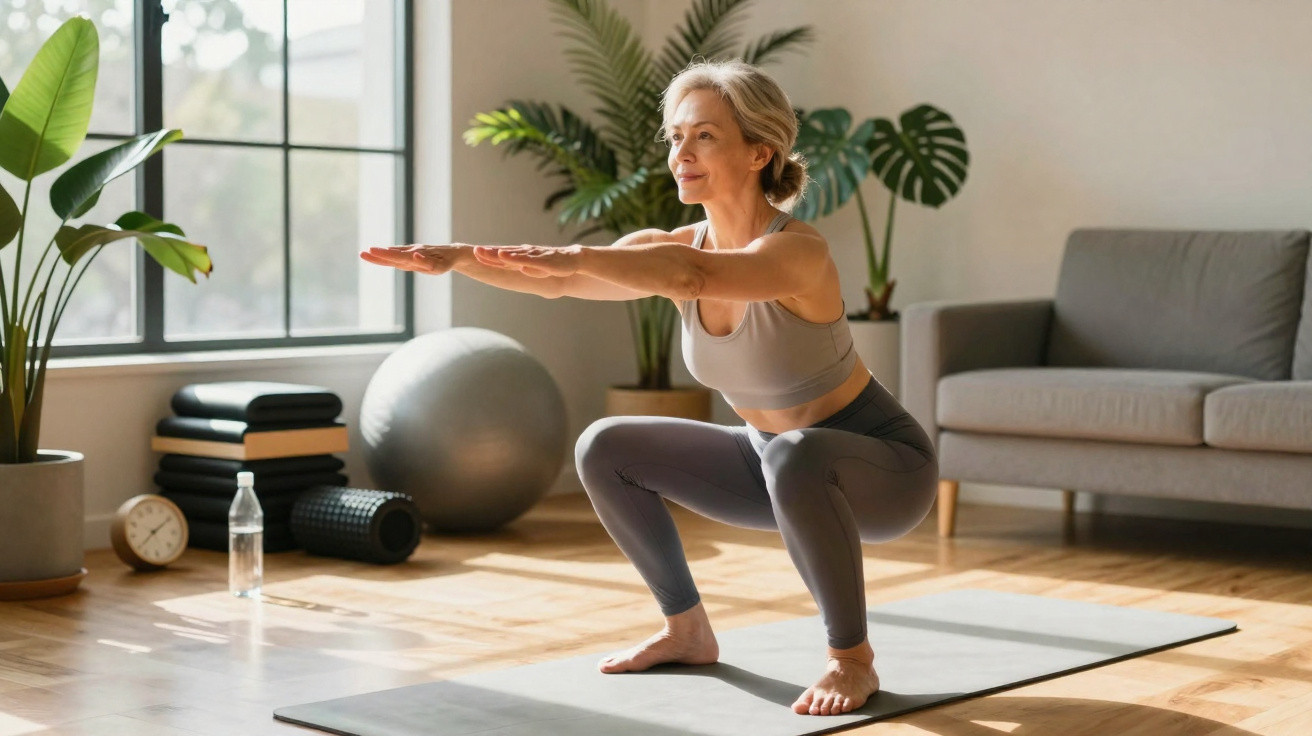
If you are over 50, you may first notice it when rising from the sofa or lowering yourself onto a chair: your body needs more strength and movements can feel less fluid. Many people then think of costly gym memberships or demanding workouts, but sports coaches are highlighting a straightforward, free exercise staple instead: a Pilates-based squat variation that needs no equipment and can be done at home every day.
Why a simple squat is so powerful as you get older
Known in the gym as a bodyweight squat, this movement is already part of everyday life: every time you sit down or stand up, you are essentially performing a squat. Whether it is from a chair, sofa, toilet or car, the body repeats the same movement pattern time and again. In later life, the ability to do this is a key factor in whether a person can remain independent or needs support.
“Anyone who can sit down and stand up safely well into old age is far better able to protect their independence in daily life.”
Over the years, the body loses muscle mass, especially in the legs and buttocks. This can make climbing stairs, carrying shopping, gardening and even short walks more tiring. Well-trained leg and gluteal muscles help counteract this. Doing squats each day provides precisely this reserve of strength - without marathon sessions or a room full of equipment.
Sports coaches point out that the toughest workout does not produce the best results; movements that transfer directly to everyday activities are more valuable. This is where Pilates comes in. The method brings together mindful breathing, correct joint alignment and controlled, functional movement. A bodyweight squat fits this approach perfectly.
Pilates squat: what it does to the body
The Pilates version of the squat does more than work the larger muscles: it helps stabilise the entire body. Practised regularly, it primarily trains:
- Thigh muscles: support stair climbing, standing up and walking for longer
- Gluteal muscles: stabilise the pelvis and reduce strain on the lower back
- Calf muscles: assist balance and steadiness when standing
- Core muscles (abdominals and deep trunk muscles): promote an upright posture and protect the spine
- Joint control at the hips, knees and ankles: reduces poor loading and helps prevent pain
There is another benefit, too: performing the movement slowly and deliberately develops the interaction between the nervous system and muscles. This improves coordination and therefore helps prevent falls - a major health consideration from the age of 60 onwards.
How people over 50 can perform the Pilates squat correctly
Technique is what makes the difference. Poor form can irritate the knees, whereas correct form strengthens them. Pilates coaches often recommend the following basic version:
Starting position: stand steadily with neutral alignment
Stand tall with your feet roughly hip-width apart and your toes pointing slightly forwards. Spread your weight evenly across the entire foot - heel, ball of the foot and toes. Keep your pelvis and spine neutral and upright, looking straight ahead.
Let your arms rest loosely by your sides to begin with. Gently engage your core, as if lightly drawing your navel towards your spine. Breathe calmly in and out without lifting your shoulders.
Lowering phase: bend your knees with control
Breathe in, keep your upper body stable, then slowly bend at the hips, knees and ankles. Imagine moving your hips backwards to sit on an invisible chair. This helps stop your knees from travelling too far forwards.
If it is useful, extend your arms in front of you. They act as a counterbalance and can improve stability. Keep your knees generally pointing in the direction of your toes rather than allowing them to collapse inwards. Your back should remain straight, not rounded.
Rising phase: use strength, not momentum
Breathe out, press your feet firmly into the floor and return to standing. Drive the movement with your legs and glutes rather than using momentum. Allow your arms to lower back to your sides.
Many coaches suggest three sets of 12 to 15 repetitions as a guide. Beginners can start with 8 well-executed repetitions. Quality matters more than quantity.
Tips for beginners and people with discomfort
Anyone who has not exercised for a while, or has knee, hip or back issues, should take particular care when starting. Small adjustments are often enough to make the movement work well.
| Issue | Practical adjustment |
|---|---|
| Feeling unsteady with balance | Hold lightly onto the back of a chair or a table |
| Knee pain | Lower only as far as remains pain-free; shift the hips further backwards |
| Weak back | Make the movement smaller, consciously lift the breastbone and increase core engagement |
| Significant general uncertainty | Start by sitting down on a chair and standing up without momentum - this also counts as a squat |
If you are unsure, have the technique checked once by a physiotherapy practice or an experienced Pilates instructor. A brief outside assessment can prevent poor postures from becoming habitual.
How often the squat can work: set realistic targets
For measurable benefits, the body needs this stimulus regularly. Many professionals advise treating the Pilates squat like brushing your teeth: as a daily habit rather than a special exercise programme.
A possible plan for people over 50 could look like this:
- Weeks 1–2: twice a week, 2 sets of 8 repetitions
- Weeks 3–4: 3 times a week, 3 sets of 10 repetitions
- From week 5: 4 to 5 times a week, 3 sets of 12–15 repetitions
If you already get up and sit down frequently, use those moments intentionally. For instance, add two controlled squats before sitting down each time - an easy way to increase everyday activity almost without noticing.
How Pilates and everyday life complement each other
Pilates aims to make movement more efficient and kinder to the joints. Combined with the squat, it creates several effects at once: greater strength, improved posture, more stable joints and more conscious breathing. After just a few weeks, many people notice that stairs feel easier and their backs feel less tired.
“Small movements repeated consistently change everyday life more than occasional peak performances at the gym.”
Anyone wanting to do more can combine the squat with other uncomplicated exercises, such as:
- A balance scale pose or standing on one leg to train balance
- Gentle standing torso rotations to improve spinal mobility
- Arm circles and shoulder rolls to ease the neck and shoulders
Risks, limits and when a check-up makes sense
For most healthy people, the bodyweight squat carries little risk. Anyone with severe joint problems, flare-ups of osteoarthritis, cardiovascular conditions or dizziness should ideally have their capacity for exercise assessed beforehand. The same applies after surgery to the hip, knee or spine.
Warning signs during the exercise include sharp knee pain, sudden dizziness, a feeling of pressure in the chest or shortness of breath. In these situations, stop immediately and seek medical advice if necessary. A mild burning sensation in the muscles, however, is normal - it shows that they are working.
Why this everyday movement can genuinely slow ageing
Ageing does not automatically mean frailty. Regularly including functional exercises such as the Pilates squat can significantly slow the loss of muscle strength and mobility. Fewer falls, greater confidence in daily life and better quality of life are tangible outcomes.
There is also a psychological benefit: when people notice what their bodies are capable of, they tend to move more overall. Walks become longer, stairs are avoided less often, and activities with children or grandchildren remain possible. The squat is therefore more than a fitness exercise - it becomes a small daily investment in an independent life in older age.

Comments
No comments yet. Be the first to comment!
Leave a Comment