
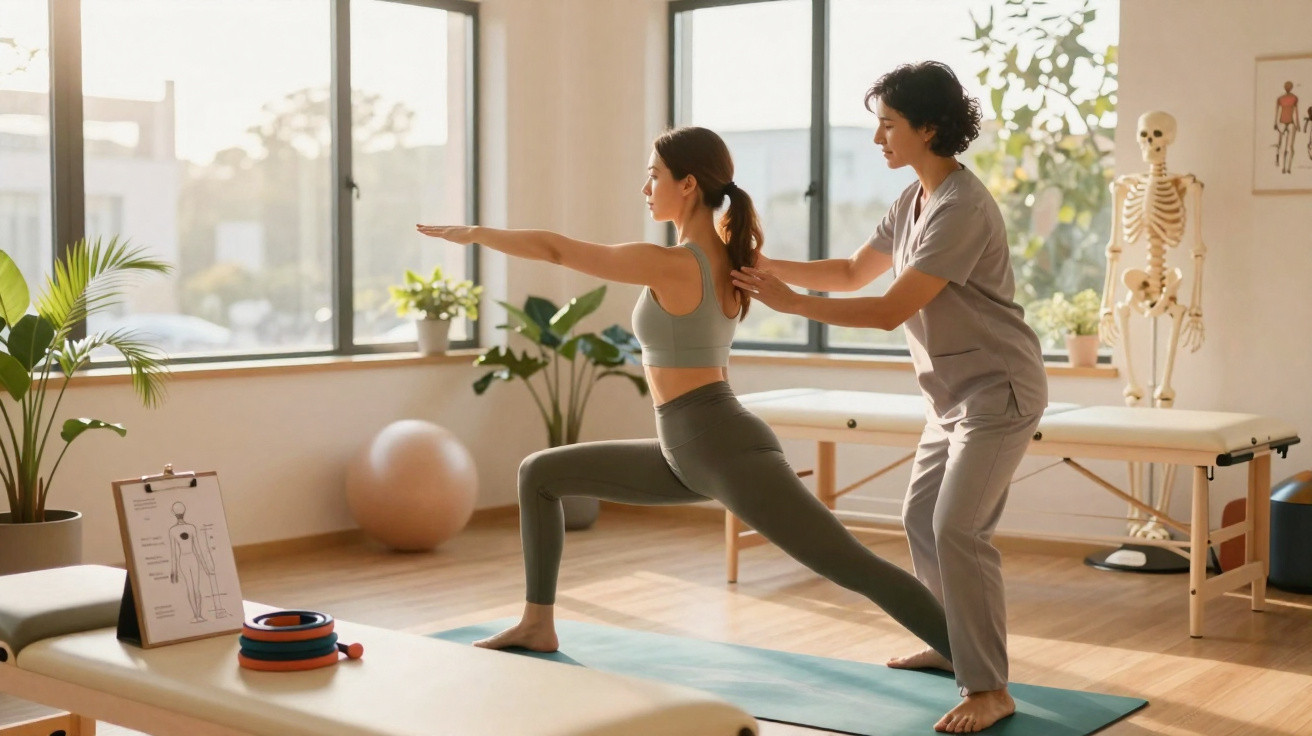
Yoga and Physiotherapy – what are the benefits of bringing these two modalities together? Are physiotherapists referring patients to Yoga more often than Pilates?
Before looking at this subject in more depth, it is helpful to define Yoga and Physiotherapy.
Yoga is an ancient discipline involving breath control, meditation and particular physical postures. It is practised for wellbeing and relaxation, while traditional Yoga teachings also offer a rich body of philosophy to investigate.
You may also be familiar with Yoga therapy. This is a holistic approach in which the therapist addresses muscular imbalances, breathing practices and meditation. People are provided with methods and skills intended to support their own capacity for healing.
Physiotherapy is a form of physical therapy. A physiotherapist identifies and addresses muscular and structural dysfunction, generally using hands-on physical techniques to treat the underlying cause of a physical issue. They work with people experiencing pain, recovering after surgery, or following recent trauma such as road traffic collisions and sporting injuries.
Both modalities have an appropriate role at different stages of rehabilitation. After orthopaedic surgery, for instance, a patient will need physiotherapy. Once rehabilitation is complete, the physiotherapist will usually encourage ongoing regular exercise.
Yoga is generally used more as a preventative or maintenance practice. At present, practising Yoga is also highly fashionable.
Yoga therapy offers a more targeted alternative. For a patient finding it difficult to return to their best possible health, it may provide the missing link. Yoga therapists are trained to offer tailored guidance on movement and breathing.
For many years, Pilates was physiotherapists’ preferred option. Postural imbalances and sedentary living can leave people with poor core strength, contributing to neck and back pain. Many physiotherapists therefore trained as Pilates instructors, allowing the advantages of both modalities to overlap.
What is changing?
Increasingly, Physiotherapists are choosing Yoga. Some medical practices now even provide on-site Yoga classes. Is this simply a consequence of the wider “Yoga Boom”, or are health professionals identifying the benefits of Yoga?
More physiotherapists are taking up Yoga themselves and, in some cases, qualifying as Yoga teachers or even Yoga therapists.
I recently delivered a lecture to second-year WITS Physiotherapy students. Each year, I speak about the comparisons between Yoga and Pilates, including why and when each modality may be recommended. The purpose of this lecture is to help students understand that both approaches have advantages and disadvantages. Pilates incorporates many Yoga principles, but breathing methods are the key distinction.
Any health practitioner or medical professional would agree that exercise can lift mood and support overall wellbeing. But does the specific form of exercise a person chooses truly matter?
The general benefits of Yoga
- Yogic practices offer clear, practical benefits to everybody, irrespective of spiritual goals.
- Yoga supports bodily health and a youthful feeling.
- It promotes mental clarity.
- It can be practised by people of every age and fitness level.
- Yoga is non-competitive.
- It strengthens intrinsic muscles while incorporating flexibility training.
- It works as both a physical and mental therapy.
- It offers a complete movement system that stretches, strengthens and tones the body, helps improve alignment, and supports the health of the whole body.
Yoga can also benefit the cardiovascular system. Its physical postures are isometric, helping to improve cardiovascular fitness and circulation throughout the body. Research indicates that consistent Yoga practice may assist in normalising blood pressure.
A slow digestive system may be helped by the massaging action of nearby muscles and increased blood circulation.
Moving joints through their full range of motion helps to mobilise them appropriately. Gentle stretches can ease muscular and joint tension, stiffness is reduced, and flexibility improves. Maintaining the physical postures also develops musculoskeletal strength and endurance.
Over time, practice may reduce stress, anxiety and fatigue. It can also improve concentration, energy and an overall feeling of wellbeing.
Many breath-control or pranayama methods calm the parasympathetic nervous system. Engaging the body’s relaxation response can help counterbalance the pressures of demanding modern lifestyles.
When the body is continually overwhelmed by excessive stimulation and demands, genuine healing can become almost impossible.
Results of combining Yoga and Physiotherapy
I regularly collaborate with physiotherapists to support rehabilitation and improve joint integrity, overall mobility, pain symptoms and stress levels.
These photographs show a patient between January and August 2019. Her symptoms included severe knee pain, ankle instability and postural alignment concerns. In March 2019, she started a consistent Yoga practice of one class per week.
The student experienced general weight loss. More importantly, however, were the wider postural improvements. Her sway-back knees improved, as did the shape of the spine’s kyphotic and lordotic curves.
From my experience of working with chronic pain and ‘yellow flags’, Yoga is a considerably more effective movement modality. Because flexibility is such a strong component, Yoga is also more beneficial for overall mobility. It provides practical tools, including meditation and pranayama, that can support recovery and change.
What Physiotherapists are saying about Yoga
“As a physiotherapist,I have practiced both Pilates & Yoga. I have referred patients to both, as I believe both encourage good postural awareness, body focus & discipline. I explain that Pilates has a much greater focus on the abdominal canister ‘core’. Whereas yoga has a focus on posture & muscle length where the abdominal canister carries out its role without focus or dedicated awareness. It happens more functionally. Personally I find that the way the breath is used in yoga is more natural, the positions more functional and the mind component refreshing and rejuvenating!
Both have a significant place in rehab-provided the right therapist is found. Two unique disciplines! I am not aware of all the variations of yoga – that I see as a positive, as within the discipline there is so much to choose from and be challenged by!”
Lindsay Harris – Physioworx
“Patient A* had chronic LBP with fear avoidance behaviours. She was too scared to move! She tried pilates but I actually asked her to stop. During Pilates she clenched all her muscle groups and battled to isolate her core. I advised Yoga as it enabled her to get some flexibility in her back movements in a gentle, controlled environment. She became more confident to move her back, while strengthening her core. Yoga helped calm her mind and reduce general anxiety.*
**Patient B* was originally a Pilates girl until I saw her. She felt that is wasn’t helping anymore. Patient has severe scoliosis and is hypo-mobile. As a result suffers with neck and back pain and very weak. The stretching exercises that yoga incorporated and core work benefited her hugely. She is a very busy lady in terms of work. Feedback was that yoga managed to target her muscle strength, flexibility as well as calm her mind.”*
Caroline Hawkins
Several online modules are available on my website under Fundamentals of Anatomy.
They are ideal resources for refreshing, revising and updating your anatomical knowledge.


Comments
No comments yet. Be the first to comment!
Leave a Comment