
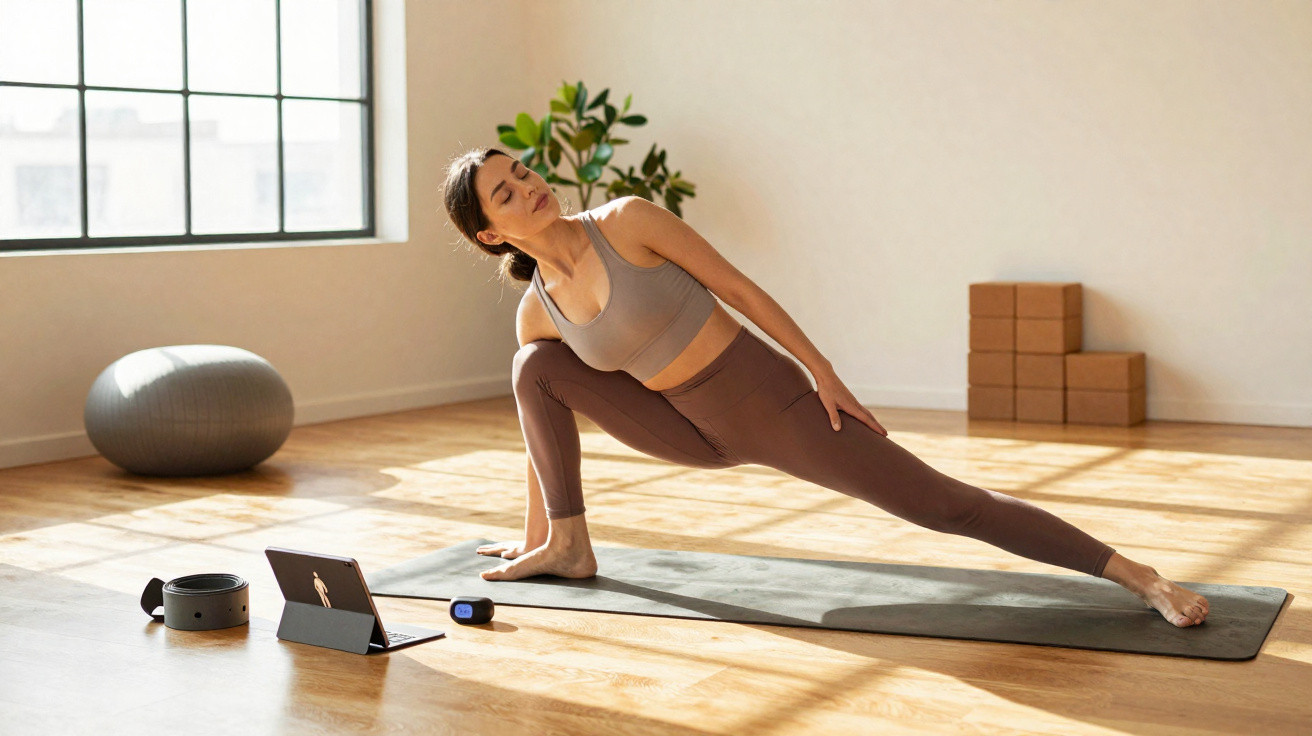
The studio is still, apart from the low drone of a heater and a handful of irregular breaths. A barefoot yoga teacher moves quietly between the mats, murmuring, “Hold… just a little longer… breathe into the stretch.” At the front, one woman trembles in Warrior II, her teeth set and gaze locked on the clock. She believes that, if she can remain there while her muscles protest, she will finally free her hips and “open” her body once and for all.
A couple of mats behind her, a man in his fifties winces as he discreetly takes weight out of his front knee. He says nothing. It is yoga, after all. Surely you are meant to tolerate it?
But what if this belief is quietly damaging people’s joints?
When “hold it longer” starts to go too far
Mention prolonged holds to yoga teachers and their reaction is often recognisable: part appreciation, part unease. They understand that remaining in a posture can develop concentration and strength, but they also know how easily a worthwhile idea can become unspoken pain.
Many people arrive at class assuming that the longer they stay fixed in a stretch, the more flexible they will get. Bodies are not quite that straightforward. Muscles have protective responses, while joints have boundaries that determination cannot override. Problems can begin when those signals are dismissed.
A teacher based in Berlin described one regular student: a graphic designer in her thirties who was set on “finally get the splits this year.” She continued deep lunges long after everyone else had left the position. At home, she added extra static stretches, holding each one for a full two minutes. Initially, she felt pleased with herself. Her Instagram photographs appeared more “bendy”.
Three months on, she arrived at class with a limp. Walking upstairs caused pain at the front of her hip. An MRI showed irritated hip flexors and an unhappy labrum. There had been no spectacular incident, only a gradual and persistent over-stretch that no one had considered challenging.
As many teachers put it, the explanation is straightforward: the nervous system is not a rubber-band factory. Keeping an intense stretch for too long may make the brain perceive a threat. Muscles then contract to guard the joint, and the tension you hoped to ease can return even more strongly the following day.
Joint tissues, including ligaments and capsules, do not rebound in the way muscles do. If they are stretched beyond their limits, they may become lax and leave the joint less stable. On the mat, that can look like striking flexibility. Away from it, it may mean unsteady knees on the stairs or a shoulder that slips a little too readily during everyday activities.
Yoga pose holds: how long is enough without risking injury?
Seasoned teachers do not frame the longest possible hold as an achievement. Instead, they encourage students to stay long enough for the body to register the position, then ease off before it becomes problematic. For most active stretches, many now suggest a useful range of around 20–40 seconds, occasionally extending to a minute where the stretch is mild and breathing remains relaxed.
The emphasis moves away from stopwatch-based boasting and towards the quality of what you feel. Where is the stretch located? Is your breathing smooth or uneven? Can you soften your jaw? If calm breathing is not possible, teachers will usually say that your body is signalling “no” to either the depth or duration of the posture.
Most of us know the experience: staying in Pigeon Pose well beyond comfort because the teacher has not yet instructed the class to leave it. Perhaps your foot begins to feel slightly numb, or there is a sharp, precise pain near the knee. You persuade yourself that it is “just tightness”.
One teacher from Toronto said she now scans the room specifically for students with that blank, disengaged expression. She gently encourages those people to come out a few breaths sooner. Since reducing hold times for deep hip openers and backbends, she has seen far fewer reports of pinching lower backs and painful knees in the days following class.
Physiotherapists treating yoga practitioners report much the same trend. Strong, dynamic flows are rarely what bring students into their clinics. More often, it is passive prolonged holds at the end of the available range, repeated week after week, that gradually strain tendons and joint cartilage. The body responds well to movement that pulses and explores a range, rather than settling at its furthest edge.
The plain reality is that a five-minute hold does not automatically make a pose “more advanced”. In some cases, it simply raises the risk. When teachers use micro-movements, progressive loading and different angles, joints often feel more secure and flexibility becomes more practical for everyday life, rather than existing only on a sticky mat.
Smarter stretching: what yoga teachers want you to do
The approach quietly preferred by many senior instructors is less theatrical and more exploratory. They guide students into a stretch, ask them to settle at roughly 6 out of 10 intensity, and keep them there for 30 seconds with even breathing. They then encourage a slow release, a shake-out, and perhaps one or two repetitions.
Some instructors combine this with “PNF-style” work: lightly contracting the muscle being stretched for a few seconds, before relaxing into a marginally deeper yet still comfortable position. It is a subtle method, but it sends a gentler message to the nervous system: you are in charge, not stuck. Over time, it can build a range of movement that is genuinely useful, rather than loose, unstable flexibility that appears only in photographs.
The error people most often admit to is pursuing sensation rather than responding to feedback. If they do not feel a substantial pull or burn, they think nothing is occurring. So they go further, rotate a little more or remain there a little longer. Joint warnings are more subdued than muscle signals, which is why sharp discomfort that feels “inside the joint” can be overlooked until it becomes a serious issue.
Teachers also frequently notice students holding their breath, tightening their glutes or locking their knees merely to maintain a posture. That is not bravery; it is the body attempting to protect itself. A considerate teacher will often advise leaving room in every stretch, both in intensity and in time. The aim is to leave the studio feeling more balanced and coordinated, rather than like an overstretched balloon.
Some teachers have begun addressing this more directly with students.
“Flexibility without control is like driving a sports car with loose steering,” says London-based yoga teacher and mobility coach Sara Lee. “Yes, you can go further and faster. But can you stop on demand? Can you change direction? That’s what keeps joints safe.”
They also ask students to look out for particular warning signs during longer holds:
- Sharp or “zappy” feelings within a joint rather than the muscle
- Numbness, tingling or a limb “falling asleep”
- Breathing that seems confined to the chest, or gripping in the jaw and neck
- Pain that intensifies the longer you remain, rather than becoming softer or more diffuse
- Soreness around joints that lasts for days after class
If any of these occur, the answer is not to force your way through. Adjust the time, the depth or the pose itself.
Rethinking how good yoga should feel in your body
A quiet change is taking place in yoga studios and living rooms. Rather than pursuing the deepest possible stretch, more students are asking: “Will my knees and hips still like this ten years from now?” That question alters the atmosphere of an entire class. Lengthy, punishing holds become less appealing, while gentle and precise work gains greater value.
For some people, this involves pairing yoga with strength training so muscles can support newly available movement ranges. For others, it simply means cutting 20 seconds from a hold and introducing some motion: a gentle rock backwards and forwards, or a spinal spiral instead of remaining motionless. Practice becomes less about spectacle and more about a conversation with the body.
To be realistic, nobody manages this perfectly every day. People will still attend demanding workshops, experiment with deep yin classes or remain in a posture slightly too long because the playlist feels perfect. The difference is the baseline. Students whose teachers have spoken openly about joint health are usually quicker to identify when something feels wrong. They come out sooner, support their knees with props and stop judging their value by the number of seconds they can hold.
That does not make yoga less spiritual or less committed. It simply makes it more sustainable. It allows yoga to become what many teachers have quietly hoped it would be: not a contest of flexibility, but an ongoing relationship with a body you want to keep walking, twisting and hugging people with, without pain.
If you have ever limped out of class after a supposedly heroic Pigeon hold, you are far from alone. The answer is not to abandon yoga or avoid stretching indefinitely. It is to reconsider your agreement with long poses. Ask your teachers how they approach timing and joint safety. Compare how your body responds after dynamic holds and after intense static ones. Pay attention to which option makes it easier to rise from the floor, sleep more comfortably or sit at your desk with less persistent pain.
Your flexibility story does not require a dramatic finale. It needs greater nuance, and perhaps quiet permission to leave the pose before the timer reaches zero.
| Key point | Detail | Value for the reader |
|---|---|---|
| Long holds aren’t always safer | Prolonged static stretches may irritate joints and overstretch ligaments | Helps you avoid “yoga injuries” that develop gradually |
| Find the sweet spot | 20–40 seconds at moderate intensity, with steady breathing, suits most active stretches | Provides a clear, practical reference point for daily practice |
| Listen to red flags | Sharp joint pain, numbness and breath-holding indicate that a pose or hold is too much | Helps you self-regulate when a teacher or video cannot see you |
FAQ:
- Is holding a yoga pose for several minutes always bad? Not necessarily. Low-intensity, gentle postures can sometimes be held for longer, particularly in yin-style practices, but they should never result in sharp joint pain, numbness or breath-holding.
- How long should I hold a stretch to improve flexibility safely? Most instructors recommend around 20–40 seconds at a comfortable intensity, repeated one to three times with slow, easy breathing.
- Why do my joints hurt the day after long yoga holds? This often suggests that the posture stressed joint structures or nearby tissues rather than only the muscle, especially when the pose was deep and passive.
- Is dynamic stretching better than static stretching in yoga? Both can work well together. Dynamic movement warms up and readies the joints, while shorter, mindful static holds can maintain or gently expand range.
- What should I do if a teacher keeps you in poses longer than feels safe? Honour your own boundaries: leave the pose earlier, modify it or use props, and, where possible, speak with the teacher after class about what you experienced in your body.

Comments
No comments yet. Be the first to comment!
Leave a Comment