
Not from exertion, but from laughter. “You’re telling me this is meant to make my whole body more stable? This?”, she asks, sceptically lifting one leg a few centimetres off the floor. The physiotherapist beside her smiles calmly, touches her hip with two fingers - and suddenly the wobbling stops. The room falls quiet as everyone watches. No gym machine, no dumbbells, no high-tech equipment. Just a tiny movement, almost imperceptible, yet somehow felt right down to the toes. We all know that moment: when something appears far too simple to be genuinely effective. Yet this is precisely where the real story begins: the story of an exercise so quiet that it barely gets noticed in everyday life, but can still transform the entire body.
The understated exercise physiotherapists keep talking about
Anyone who regularly visits rehabilitation clinics, physiotherapy practices or sports medicine clinics will eventually hear the same phrase: “We start with the core.” This rarely means sculpted abs. Instead, it refers to a deep, unseen layer of muscles that is more readily felt than seen. For this, many therapists use an exercise that looks so ordinary you would probably scroll past it immediately on social media. Yet it is a quiet favourite for people with lower back pain, marathon runners, office workers with rounded backs and even older people worried about turning an ankle.
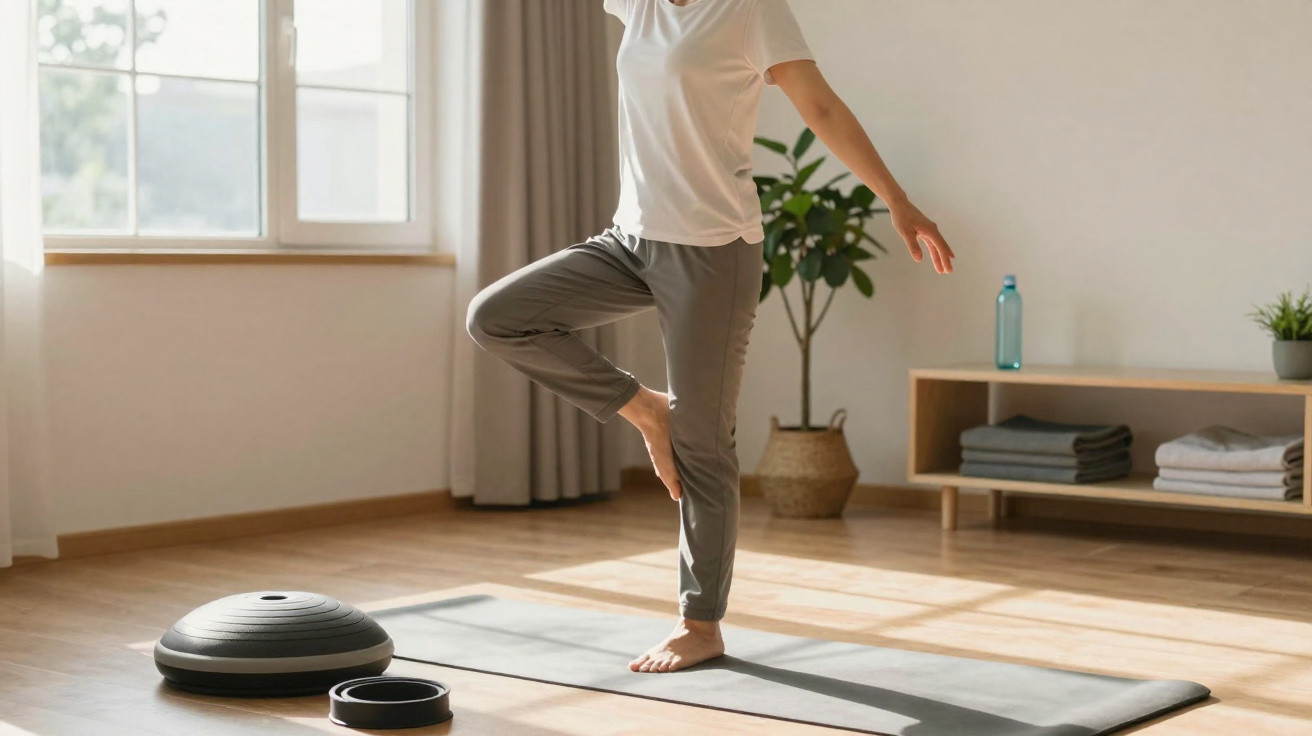
The exercise is the single-leg stand: simply standing on one leg. It may sound like something for nursery school, but in practice it is a compact stress test for the whole body. There is nothing dramatic about it, no noise and no “burn” familiar from fitness videos. Look more closely, however, and it becomes clear that everything is involved: the foot, knee, hip, torso and even the eyes. That is what makes this exercise so deceptively effective.
A physiotherapist told me about a patient in his early 40s: an IT specialist who worked from home a great deal and described himself as “actually quite fit”. He went jogging twice a week, but had experienced back pain for months. The MRI showed nothing serious - a familiar scenario. At the first appointment, the therapist asked him simply to stand on one leg. Five seconds later, his arms were flailing, his hip had dropped to one side and his foot was struggling as though it were on ice. The man started laughing, then swearing. “That can’t be possible.” By the end of rehabilitation, he could stand steadily on one leg for 30 seconds. The pain had not vanished by magic, but it was noticeably reduced; his walking was more stable and his confidence in his own body was considerably greater. A small exercise, with a major effect.
When we stand on one leg, a finely coordinated process takes place in the background. Countless small muscles in the foot must balance contact with the floor. The knee responds to every shift of a millimetre. The hip works to keep the pelvis level. Deep abdominal and back muscles prevent the upper body from tipping away. Meanwhile, the brain continuously receives fresh information from the balance system, joints and muscles. Put simply, the single-leg stand makes the body work as a team. In the view of many physiotherapists, that is the key: it is not one muscle being trained, but the communication between them. Let’s be honest: hardly anyone really does this every day. That is exactly where untapped potential lies.
How to practise the single-leg stand as you would in physiotherapy
The basic version looks harmless. Stand barefoot or in socks on a firm surface, perhaps beside a shelving unit or the kitchen worktop. Spread your weight evenly through one foot, then slowly lift the other foot just a few centimetres. Keep your hips as level as possible and focus your gaze on a point at eye level. Start by holding for only 10–15 seconds, then swap legs. If you are new to it, you can touch the wall with one finger at any point - that is not cheating, but part of the learning process. Many therapists suggest building the exercise into short everyday moments: while brushing your teeth, waiting for the kettle to boil or standing on the platform.
The most common mistake? Too much ambition and too little calm. Many people lift the free leg too high, tense their shoulders, hold their breath and battle more with their facial expression than their balance. Another classic error is allowing the pelvis to drop to one side while the knee of the standing leg collapses inwards. In a clinic, this is often the point at which the therapist lightly corrects the hip with a hand, and you suddenly understand how “upright” is supposed to feel. Wobbling, losing balance, putting the foot down and starting again are all normal when you begin. The body learns. And yes, a little frustration is part of the process.
Many physiotherapists put it in terms similar to this note I wrote down:
“The single-leg stand is like a mirror for stability. It shows you where you compensate, where you are weak - while also giving you a tool to work on exactly that.”
To use the single-leg stand more purposefully, try these small variations that are particularly popular in clinics:
- Single-leg stand with your eyes closed (only if you can stand safely and have something within reach to hold on to)
- Single-leg stand while slowly turning your head right and left
- Single-leg stand on a folded towel or thick mat
- Single-leg stand while moving a water bottle sideways with your free hand
Each variation raises the difficulty slightly. The core principle remains the same: minimal time and effort, with a substantial benefit for stability in daily life.
More everyday steadiness than we care to admit
Walk consciously through a busy supermarket once, and you will start spotting “single-leg stand moments” everywhere. A woman bending down in the vegetable aisle and unconsciously lifting one foot. A child standing on one leg while tying their shoes. An older man briefly supported on one foot as he gets onto a bus. Daily life tests our balance far more often than we realise - we tend to notice only when something goes wrong: stumbling on the stairs, taking an uneven step off a kerb or turning an ankle on wet leaves. Stability may seem unremarkable until it is missing.
Physiotherapists often speak of patients who wanted just one thing: “I want to be able to go quickly round a corner again without being afraid” or “I want to stand on a ladder without feeling unsteady”. This is not about records or sporting badges. It is about small degrees of freedom in everyday life. Balance exercises such as the single-leg stand act as a quiet safety net. Regular practice reduces the risk of falls, puts less strain on joints and also builds confidence in your own body. That has a mental effect too.
Perhaps that is the exercise’s hidden appeal: it requires no perfect set-up, trainer or app. It tolerates breaks, can fit into every stage of life and develops with you - from the first unsteady seconds to more complex versions that challenge even committed recreational athletes. You can begin in the living room and continue on a beach during a holiday. If you are not keen, simply do it while brushing your teeth after all. Stability builds quietly, in portions of seconds, almost invisibly. But you feel it when life briefly becomes unsteady.
| Key point | Detail | Benefit for the reader |
|---|---|---|
| Single-leg stand as the central exercise | A simple balance exercise that can be done anywhere and is widely used by physiotherapists | Readers gain a practical tool they can use immediately without equipment |
| Whole-body stability rather than training individual muscles | Activates the muscles of the feet, legs, hips and torso, as well as the balance system, at the same time | Explains why small exercises can have a major effect in everyday life and when dealing with pain |
| Fitting it into daily life | Short sequences while brushing teeth, cooking or waiting, with simple progressions | Makes it more likely that training will genuinely become a routine and remain effective over time |
FAQ:
- How often should I practise the single-leg stand? Many physiotherapists recommend practising 3–5 times a week, with 2–3 sets per leg of 20–30 seconds each. Short sessions more often are better than long sessions rarely.
- What if I can barely stand for more than 5 seconds? Then you are starting in exactly the right place. Use a wall or the back of a chair, touch it lightly with one finger and gradually extend the time. Progress can become noticeable within a few weeks.
- Is the single-leg stand suitable if I have knee pain? Often it is, provided it is introduced cautiously and adjusted according to pain. In many cases, it is used in rehabilitation programmes. If pain is acute or unclear, adapt it only in consultation with a healthcare professional.
- Is this one exercise enough for my stability? It is an excellent starting point and a foundational building block. Many therapists combine it with strengthening exercises for the torso, hips and feet to enhance the result.
- At what age is the single-leg stand worthwhile? Essentially, from the moment a child can stand safely through to old age. People over 60 in particular benefit greatly, because good balance can help prevent falls and fractures.




Comments
No comments yet. Be the first to comment!
Leave a Comment