

Most people eat far fewer vegetables than they should, with consequences for their health.
At the same time, the range of vegetables we grow is steadily narrowing, further reducing diversity in our diets.
Vegetable biodiversity and healthier diets
A new report from an international group of specialists in nutrition, agriculture and botany, published in Proceedings of the National Academy of Sciences, argues that embracing vegetable biodiversity may be essential for improving both human health and the health of the planet.
Agricultural scientist Maarten van Zonneveld, who headed the research while at the World Vegetable Center, says current agricultural approaches cannot adequately address the world's nutritional challenges.
"The solution isn't simply to grow more vegetables – it's also to grow more kinds of vegetables," he says.
"Much of the vegetable biodiversity we need is still out there – in traditional varieties and their wild relatives. The urgency is to conserve it properly so that we can use it wisely to diversify diets amid climate change."
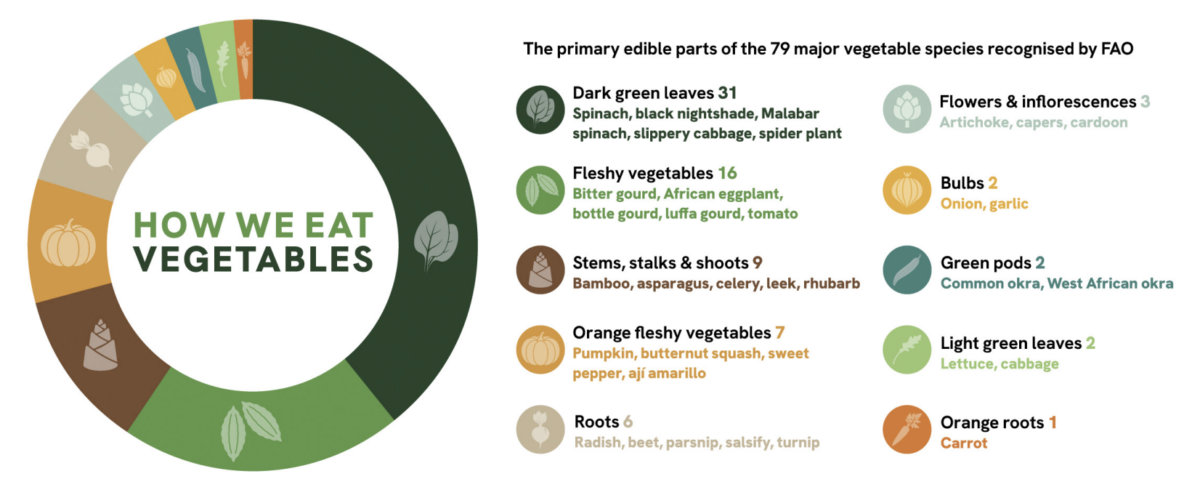
Diversity in the primary edible parts was assessed across the 79 major vegetable species listed in FAO's The Plants that Feed the World. Note that legumes are not included here, due to classification. (van Zonneveld et al., *PNAS, 2026)*
The study indicates that many vegetables high in minerals and vitamins are being overlooked, despite potentially being better adapted to local cultivation conditions in different parts of the world.
Globally, people typically eat around 40 percent fewer vegetables than are recommended for a healthy diet.
This is troubling because insufficient vegetable consumption ranks among the five leading dietary risk factors behind the global burden of disease.
When household budgets are stretched, vegetables are often among the first items removed from the shopping list. Farmers, meanwhile, commonly regard them as a greater financial risk than other crops because they perish quickly and have limited shelf lives.
Why vegetable varieties are disappearing
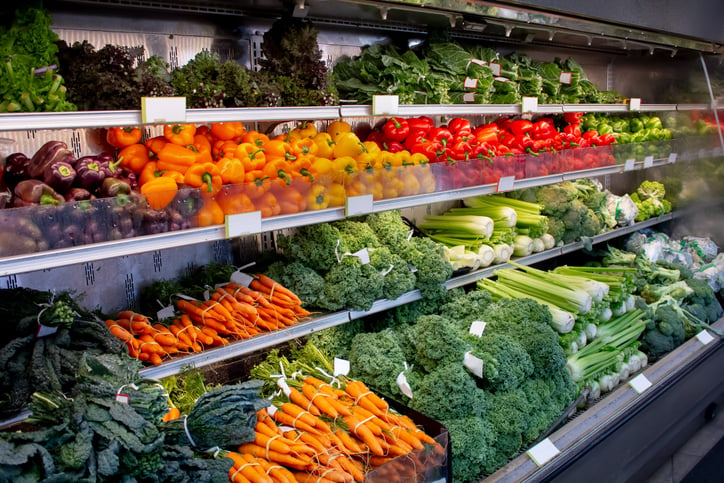
The diversity of vegetables is dwindling. (Photography By Tonelson/iStock/Getty Images Plus)
Before farming was industrialised, a far broader assortment of plants was cultivated as food.
There are, for example, more than 4,000 varieties of potato, yet only roughly five to eight varieties are widely used in the United States.
Agricultural selection, monocultures designed for mass production, and genetic modification, alongside the supply chains distributing their products, have all reduced the variety of vegetables arriving on our tables.
A review by the UN Food and Agriculture Organization (FAO) estimates that 24 percent of vegetable wild relatives assessed at species level face a risk of extinction.
As vegetable genetic diversity declines, so too do their nutrients and our capacity to adapt crops to changing climatic conditions.
"A few species, such as lettuce, onions, and tomatoes, have become global crops and are part of diets worldwide," van Zonneveld and colleagues write.
"Many others, such as spider plant, slippery cabbage, and bitter gourd, which are typically denser in micronutrients and better adapted to challenging and resource-limited environmental conditions, are available only regionally, and very often neglected in large-scale food policies and strategies."

Vegetables that could diversify regional food crops
Spider plant, a dark-green leafy vegetable cultivated in Africa, has been recognised for its climate-change resilience as well as its high content of essential nutrients.
"Currently, only a few local varieties are conserved in gene banks, with many gaps in collections, constraining breeding and the development of improved varieties for larger-scale production," van Zonneveld and colleagues note.
Slippery cabbage is among the Pacific's most popular dark-green leafy vegetables. The researchers say it could substantially improve nutrition, particularly for women and children.
Bitter gourd, another vegetable resilient to climate conditions, is popular across Asia and the Caribbean. It has numerous wild relatives which, the researchers believe, could improve crops in these tropical regions.
Then there is the familiar pumpkin, which tolerates drought and heat while producing fruit rich in beta-carotene. Although commercially important, the researchers say "its genetic resources remain underutilized and poorly conserved".
The researchers consider these four vegetables promising initial options for regional crop diversification, though many more are available.
We simply need to begin cultivating and eating them before they vanish.
Related: Scientists Found a Remarkable Way to Help Kids Like Vegetables
"The ongoing biodiversity loss for these and the other 1,480-plus vegetable species occurs at a time when global food systems urgently need diversification," the team concludes.
"Alignment under a global initiative would ensure that local and regional efforts translate into improvements in diets at both the local and global levels."
Closer to home, there are several ways to bring greater variety into our diets.
Keen gardeners can seek out 'landrace' and 'heirloom' vegetable varieties for their gardens.
Saving seeds from vegetables to plant again the following year is another effective way to sustain biodiversity – and could even result in your own distinctive varieties.
Buying food at farmers' markets and independent grocers can also help you discover a wider selection of vegetables, as well as fruit, for your diet.
You may even discover a new favourite.
The research was published in PNAS.
This article was fact-checked by Rachel Garner and edited by Peter Dockrill. While we take pride in our process, we are only human. If you spot an error, please let us know.





Comments
No comments yet. Be the first to comment!
Leave a Comment