

Her immune system had already been linked to illnesses affecting her liver, bile ducts and large intestine. A finding in her blood then pointed to another organ under attack: her stomach.
A 40-year-old woman in China had severe iron deficiency, yet doctors found no evidence that she was bleeding. Instead, it appeared that her body was unable to take in enough iron from the food she ate.
The explanation was a fourth autoimmune disease.
Autoimmune diseases arise when the immune system, ordinarily responsible for fighting infections, wrongly identifies the body's healthy cells as dangerous and attacks them.
The unusual case, published in Frontiers in Immunology, also posed a diagnostic question for the doctors: could the woman's several autoimmune conditions be connected by a rare syndrome?
Four autoimmune diseases and unexplained iron deficiency
One of the woman's existing diagnoses was ulcerative colitis, which causes inflammation of the large intestine's lining and may lead to pain, diarrhoea and bleeding. However, her ulcerative colitis was in remission when doctors began examining her iron deficiency, making bleeding from the intestine less probable.
She also had autoimmune hepatitis, a disease in which the immune system attacks and inflames the liver by mistake. Unlike viral hepatitis, it does not result from an infection.
Her third condition was primary sclerosing cholangitis. This illness scars and constricts the ducts that transport bile from the liver. Bile is a fluid that enables the body to digest fats.
Blood tests showed that her haemoglobin level had dropped to 89 grams per litre. Haemoglobin is the protein in red blood cells that transports oxygen throughout the body.
Clinicians looked for where blood might be being lost. Multiple tests detected no concealed blood in her stool, while a gynaecological examination identified no obvious gynaecological cause of blood loss.
That led to a different explanation: her digestive system might no longer be absorbing sufficient iron.
When the doctors examined her stomach, they found that a section of its inner lining was markedly thinned. Microscopic examination showed immune cells inflaming the tissue. Numerous cells that would normally make stomach acid were either damaged or absent.
The woman also had antibodies targeting the stomach's acid-producing parietal cells.
Taken together, the findings established that this patient had a fourth autoimmune disease: autoimmune gastritis.
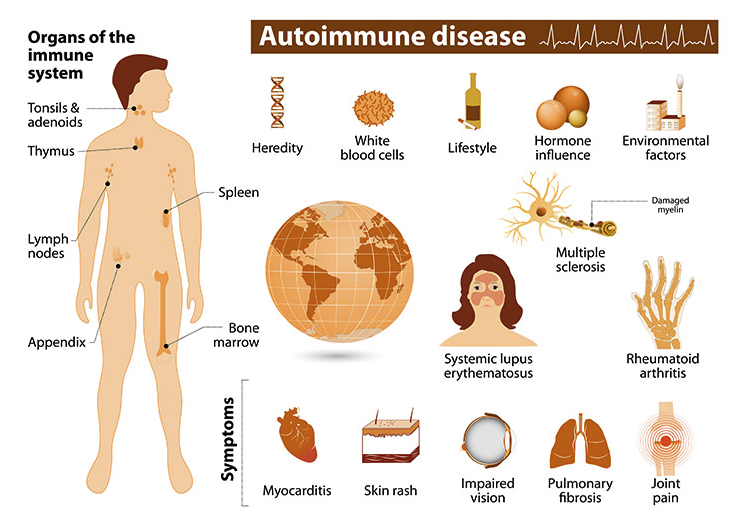
Numerous factors, genetics among them, affect a person's susceptibility to autoimmune diseases. (NIEHS)
How autoimmune gastritis affects iron absorption
Stomach acid has functions beyond breaking down food.
It also prepares iron from the diet to be absorbed in the small intestine. As autoimmune gastritis destroys the acid-secreting parietal cells, the resulting reduction in stomach acid may make iron more difficult to absorb, even where someone's dietary iron intake is sufficient.
The condition may eventually disrupt the absorption of vitamin B12, which the body requires to produce healthy blood and nerve cells. The woman's B12 levels nevertheless remained normal, in line with evidence that iron deficiency may appear as an earlier warning sign.
Why APS-3B was considered
The combination of illnesses resembled a rare disorder known as autoimmune polyglandular syndrome type 3B, or APS-3B. In this syndrome, autoimmune thyroid disease occurs alongside autoimmune diseases of the digestive system.
The woman did have hypothyroidism, which means that her thyroid hormone levels were insufficient.
However, her thyroid had been surgically removed because of thyroid cancer. Hypothyroidism is an anticipated outcome when the gland responsible for making these hormones has been removed.

Doctors lacked the test results or tissue evidence required to demonstrate that her thyroid had likewise been attacked by her immune system. Therefore, while the case resembled APS-3B, it did not establish that she had the syndrome.
This left the woman with four confirmed autoimmune diseases. The clinicians concluded that autoimmune gastritis, through its effect on iron absorption, was responsible for her iron-deficiency anaemia.
"This case indicates that when a patient has multiple autoimmune diseases, especially those involving the gastrointestinal tract, the possibility of autoimmune polyglandular syndrome should be considered," they explain in their case report.
Cases involving multiple autoimmune diseases are uncommon, although they have occurred before. ScienceAlert previously covered a woman whose three autoimmune conditions entered remission after an experimental immune "reset".
Related: Study of a Million Blood Cells Helps Explain Why Women Face More Autoimmune Disease
The new report concerns just one patient. It cannot establish how frequent this combination is, whether one disease caused another, or whether stomach testing should be undertaken for everyone with several autoimmune diseases. Some details from the woman's earlier medical history were also not available.
Doctors prescribed iron supplements and intended to monitor her vitamin B12 and folate levels. They also planned a further stomach examination with biopsies in 1–2 years, since autoimmune gastritis may raise the long-term risk of certain stomach tumours.
The case demonstrates that unexplained iron deficiency does not invariably result from diet or blood loss. In a person who already has an autoimmune disease, it could indicate that the immune system is attacking an additional part of the body.
The research appeared in Frontiers in Immunology.
This article was fact-checked by Rebecca Dyer and edited by Rebecca Dyer. Although we take pride in our process, we are only human. If you notice an error, please let us know.





Comments
No comments yet. Be the first to comment!
Leave a Comment