
When the batteries in a television remote run flat, you may start searching through a desk clock for replacements.
That is not usually how we regard the human body. Yet scientists are starting to investigate whether the same principle could apply at a cellular level.
Mitochondrial transplants reach a human eye
In animal experiments, researchers have tested transplanting mitochondria - microscopic structures that provide cells with energy - into injured tissue, aiming to give weakened cells a fresh source of power.
They have now injected them into a human eye for the first time.
Doctors took mitochondria from cells obtained through a biopsy of a young woman's leg, then carefully injected them into the vitreous fluid of both eyes. The woman had severe vision loss.
According to a preprint case report led by neuroscientist David Putrino of the Icahn School of Medicine at Mount Sinai, and published on Research Square, no harmful effects occurred. That is an important early sign that the procedure itself may be sufficiently safe for further study.
More intriguingly, although the patient's sight was not restored, there may also have been a positive effect.
Mitochondria are minute cellular batteries, turning food and oxygen into energy that cells can use to carry out their functions.
Certain cells depend particularly heavily on mitochondrial energy. These include retinal ganglion cells, the neurons that carry visual information from the retina to the brain. Putrino and colleagues say these cells have among the greatest energy requirements in the central nervous system.
An interruption to the blood and oxygen supply can damage mitochondria, potentially contributing to the chain of events that destroys retinal ganglion cells.
The aim is not for transplanted mitochondria to bring dead neurons back to life. Instead, healthy mitochondria could potentially reinstate energy production in retinal ganglion cells that remain alive enough to be saved.
Animal research has found that retinal cells can take up transplanted mitochondria, and that the transplants may even help some retinal ganglion cells survive an injury.
For one young woman, this prospect provided a glimmer of hope after more conventional approaches had produced no result.
The patient's optic-nerve damage
At age 26, she experienced a severe brain haemorrhage and was not taken to hospital until an estimated 18 hours later. Emergency surgery saved her life, but the extended deprivation of blood and oxygen to her optic nerves left her almost entirely blind in both eyes.
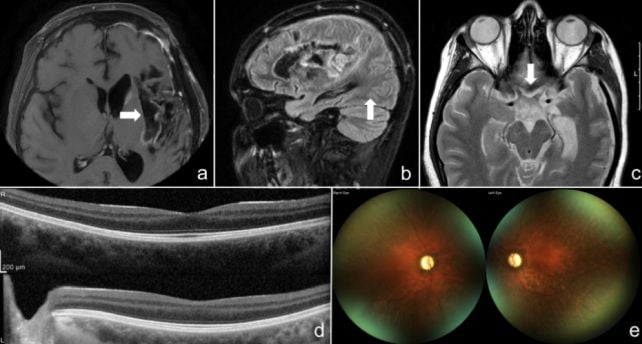
Brain and eye imaging showing damage to the patient's optic nerves and retinal ganglion cells before the mitochondrial transplant. (Putrino et al., Research Square, 2026)
Eight weeks later, visible atrophy had developed in her optic nerves. By the time she received treatment, roughly three months after the event, there had been no meaningful improvement in her profound visual impairment.
That did not necessarily mean there was no prospect of recovery. Scans showed that the retinal nerve-fibre and ganglion-cell layers, although severely thinned, had not vanished completely. Measurements of brain activity also indicated that some visual information was still reaching the visual cortex.
A mitochondrial transplant might therefore have been able to restore energy to the cells that remained.
To reduce the chance of an immune reaction during transplant procedures, a patient's own biological material is generally the safest option. Doctors therefore collected a biopsy from her thigh muscle and processed it to isolate tens of millions of mitochondria from its cells.
While they were still fresh, the mitochondria were injected into the jelly-like fluid within each eye.
Within days, a change emerged.
What happened after the mitochondrial injections
During the 71 days before treatment, doctors recorded 45 measurements of how her pupils responded to light. None showed a normal response.
Only a few days after the injections, both pupils began to display some normal responses. Researchers also detected an organised response in the visual cortex during three separate brain-recording sessions, conducted 3, 44, and 45 days after treatment.
This was not a restoration of sight: the patient's visual acuity remained essentially limited to light perception, with no measurable change after treatment.
The pupil responses were not permanent either. The final normal response in the left eye was recorded on day 11, whereas the right eye continued to show occasional normal responses until day 39.
There are significant caveats. This involved only one patient and no controls. There was also no direct evidence that the transplanted mitochondria entered her retinal ganglion cells. Finally, the authors emphasise that this case cannot establish causation.

What is known is that the procedure caused no serious adverse effects, and her body did not produce a dangerous immune response.
Related: First-of-Its-Kind Treatment Boosts Vision in Human Trial, Scientists Report
The research also identifies a clear direction for future investigation. Because the changes were temporary, one possibility is that damaged cells may require repeated doses of healthy mitochondria for any benefit to continue.
Before that, however, researchers must establish clearly whether the transplanted mitochondria caused the observed changes.
If they did, using cellular batteries from elsewhere in a patient's body could someday provide a new way to save damaged cells in the eye.
"Now that we've shown that we can do this safely," Putrino told Nature, "we are working with the FDA to come up with a protocol for repeated serial mitochondrial injections."
The findings are available on Research Square.
This article was fact-checked and edited by Fiona MacDonald. While we take pride in our process, we are only human. If you spot an error, please let us know.





Comments
No comments yet. Be the first to comment!
Leave a Comment