

Whether we have plenty of motivation or none at all influences our daily lives in both major and minor ways. From switching careers to simply changing television channels, our choices are shaped by what drives us and by the rewards we value.
A new study in PNAS, led by researchers at Nagoya University in Japan, has identified an important role for neurons that make the chemical orexin in rats’ motivation to obtain food rewards.
These neurons sit in the brain’s hypothalamus. Earlier research has associated them with wakefulness, energy use, and motivation. The team behind the new work set out to examine that motivational connection in greater detail.
"A potential mechanism for translating expectations into sustained action."
– Neuroscientist Hiroyuki Mizoguchi
Orexin neurons and food-reward motivation
The experiments revealed orexin’s moment-by-moment effects, showing how closely it is involved in judging whether a possible reward justifies the effort needed to gain it – a vital calculation in motivation.

In their published paper, the researchers write: "Our observations highlight that orexin activities are implicated in the motivational process in rats and that dynamic changes in activation of orexin neurons may be involved in reward-seeking behavior based on reward prediction."
They add: "In particular, orexin neuron response depends on degree/size of effort; these changes may indicate expectation for incentive against one's efforts."
Using genetic modifications, the scientists could artificially increase or suppress activity in orexin-producing neurons. During food-reward tests, rats worked harder to earn food when these neurons were activated, but stopped trying sooner when the neurons were inhibited.
Real-time observations of naturally occurring orexin neuron activity also found that it rose before rats received a reward, then fell once the reward had been delivered. When an anticipated reward failed to arrive, however, orexin activity stayed elevated.
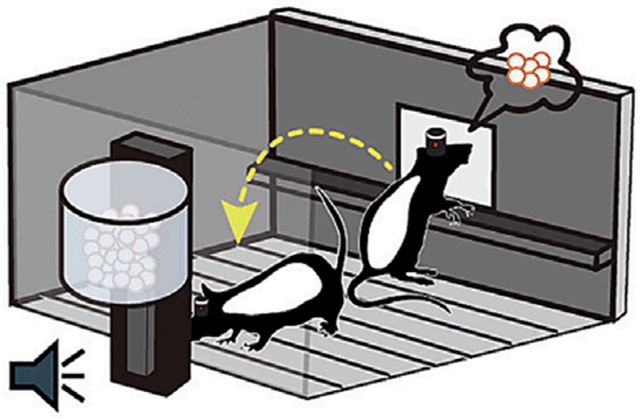
Rats completed tasks in return for food rewards. (Dong et al., PNAS, 2026)
The greater the work required from the rats to secure a reward, the stronger the activity in these neurons became. This indicates that orexin activity could potentially serve as a marker for the effort involved in chasing an expected reward.
"Our study demonstrated significant changes in orexin neuron activity depending on expected rewards and the effort required, suggesting a potential mechanism for translating expectations into sustained action," says neuroscientist Hiroyuki Mizoguchi of Nagoya University.
How orexin activity may sustain motivation
In additional experiments, the researchers controlled orexin neuron activity while the rats were expecting rewards. Lowering that activity appeared to diminish motivation, while raising it was not associated with greater motivation.
The neurons may therefore be essential to maintaining motivation at a particular baseline, rather than functioning as a simple control that can be turned up and down.
The researchers write: "Therefore, orexin is crucial for linking predicted expectations with motivated behavior," and "Moreover, optimization of orexin activity is necessary to overcome difficulties during motivated behaviors."

Naturally, these results must still be applied to the human brain. Yet humans also possess an orexin system, making this a significant avenue for future studies of committing to a task and remaining committed to it.
Disrupted motivation is associated with several mental health disorders, including depression and addiction. Understanding more about the brain’s orexin processes could therefore also help improve treatment for these conditions.
That possibility remains distant for now. The researchers next intend to investigate the incoming and outgoing brain circuits connected to orexin neurons, to establish the natural sequence of events that switches them on or off.
Related: One Brain Chemical May Be Key to Breaking a Habit, Study Finds
Implications for motivated behaviour
Because motivation is such a basic force behind behaviour, fresh insight into its workings is likely to carry broad implications.
The researchers write: "A better and further understanding of orexinergic mechanisms underlying motivated behaviors would provide insights into the ways that motivation can be developed, and the disorders can be overcome."
The research was published in Proceedings of the National Academy of Sciences.
This article was fact-checked and edited by Rebecca Dyer. Although we take pride in our process, we are only human. If you notice an error, please let us know.






Comments
No comments yet. Be the first to comment!
Leave a Comment