

Popular semaglutide weight-loss medicines, including Ozempic and Wegovy, may act through a more intricate process than previously thought.
Although their impact on weight is widely understood to stem in part from appetite reduction, fresh research in mice indicates that the medicines’ lasting weight-loss effects involve more than simply curbing hunger.
Semaglutide and the role of ‘hunger neurons’
A new study published in PNAS reports that brain cells sometimes called ‘hunger neurons’ may have to remain functional for semaglutide to achieve its complete weight-lowering effects.
At face value, the result appears counterintuitive: why should a weight-loss medicine rely on brain cells that are associated with stimulating hunger?
Mateus d'Ávila at Yale University and colleagues examined brain cells involved in controlling the body’s energy balance. Known scientifically as AgRP neurons, these cells switch on when the body requires energy.

Medicines including Ozempic and Wegovy may function in a more complex manner than we had realised. (imyskin/Canva)
"AgRP neurons are often described simply as 'hunger neurons,' but that is an oversimplification," d'Ávila told ScienceAlert.
"Previous work from our lab at Yale and others has shown that these neurons coordinate a much broader response to energy deficit, including how the body mobilizes and uses stored energy, like fat."
Using several methods, the scientists impaired the function of these cells in female mice before administering semaglutide.
Semaglutide imitates a naturally occurring hormone released after a meal, which sends a ‘you’re full’ message to the brain. It suppresses appetite, delays stomach emptying and assists with blood-sugar regulation.
AgRP neurons helped sustain semaglutide weight loss
During semaglutide treatment, female mice with disrupted ‘hunger neurons’ still consumed less food.
Yet the metabolic response required to preserve the medicine’s full weight-lowering effect was diminished. Within 15 days, these mice had regained the weight they had lost, whereas mice with normally working neurons retained their weight loss.
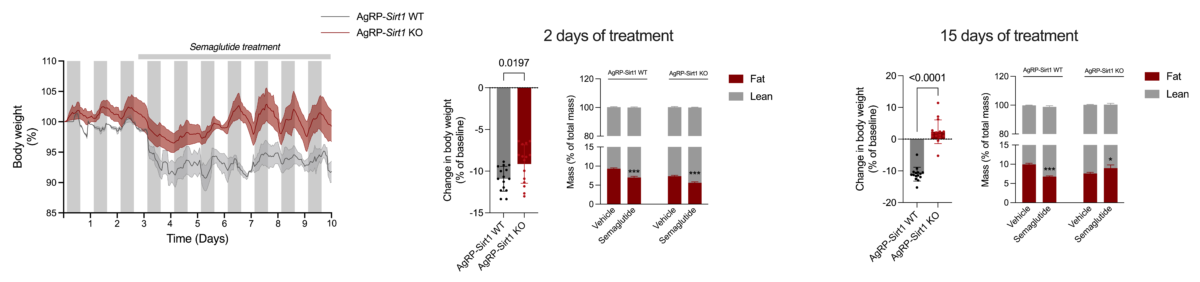
Female mice whose AgRP neurons functioned normally sustained semaglutide-induced weight loss, whereas mice with disrupted Sirt1 signalling in these neurons regained the weight they had lost. The graphs also display differences in fat mass after 2 and 15 days of treatment. (d'Ávila et al., *PNAS, 2026)*
Most notably, the animals that put weight back on were nevertheless eating less. Some even ate marginally less than the other mice, yet were unable to sustain their weight loss.
The findings indicate that, in female mice, semaglutide’s complete weight-lowering action cannot be accounted for by lower food consumption alone. Impairing AgRP neurons reduced the release of energy from fatty tissue.
Further experiments supported this result. Either disrupting the hunger neurons or blocking a signalling route that enables the body to release stored fat weakened the medicine’s weight-lowering effects.
The team additionally observed that extended semaglutide treatment altered markers of cellular activity, energy expenditure and links to other neurons within AgRP cells.
Important limits of the mouse research
There are, however, significant limitations to consider.
The work involved mice rather than humans, and the strongest effect was seen in females. Under the tested conditions, male mice did not produce the same result. The mice’s diet and the technique used to impair the neurons also influenced the results.
"This is a preclinical mechanistic study, so our findings should not currently be used to guide how people take semaglutide or other GLP-1 drugs," d'Ávila said.
The researchers did not make a direct comparison between semaglutide and older appetite-suppressant medicines. As a result, it remains premature to say that this mechanism accounts for why semaglutide might deliver more durable weight loss.
Earlier research helps show why the new results came as such a surprise.
A 2025 mouse study found that rapidly acting GLP-1 medicines quickly suppressed AgRP neurons, with stronger suppression linked to a larger fall in food intake. Artificially switching the neurons back on partially restored eating.
Related: Study Identifies a Concerning New GLP-1 Drug Side Effect That Is Rarely Discussed
A separate mouse study, previously reported by ScienceAlert, identified another set of brainstem neurons required for semaglutide’s effects on appetite and weight, but not for its nausea-like side effects.
Rather than challenging those short-term appetite results, the latest study identifies a separate function during extended treatment: in female mice, normally functioning AgRP neurons helped maintain semaglutide-induced weight loss even as the medicine continued to reduce food intake.
More research will be required to establish whether people have a comparable system.
If verified, this discovery might help account for why individuals respond differently to the same medicine and could potentially inform the development of more effective treatments.
The study appeared in PNAS.
This article was fact-checked by Fiona MacDonald and edited by Peter Dockrill. Although we take pride in our process, we are only human. If you notice an error, please tell us.






Comments
No comments yet. Be the first to comment!
Leave a Comment