

The liver ranks among the most extraordinary organs in the human body.
This powerhouse carries out roughly 500 essential functions, from processing nutrients to removing harmful substances from the blood.
Despite facing chemical toxins every day, the liver remains remarkably youthful because it has the unusual capacity to regenerate.
Still, even this dependable organ does not last for ever. As the body ages, the liver ages with it, becoming more vulnerable to several forms of fatty liver disease.
What if an ageing liver could be helped back towards a more youthful condition?
Hesperetin and liver ageing
A new study, published in npj Aging, brings that prospect a little nearer. In mice, researchers used a compound present in citrus fruits to slow, and even reverse, indicators of liver ageing.
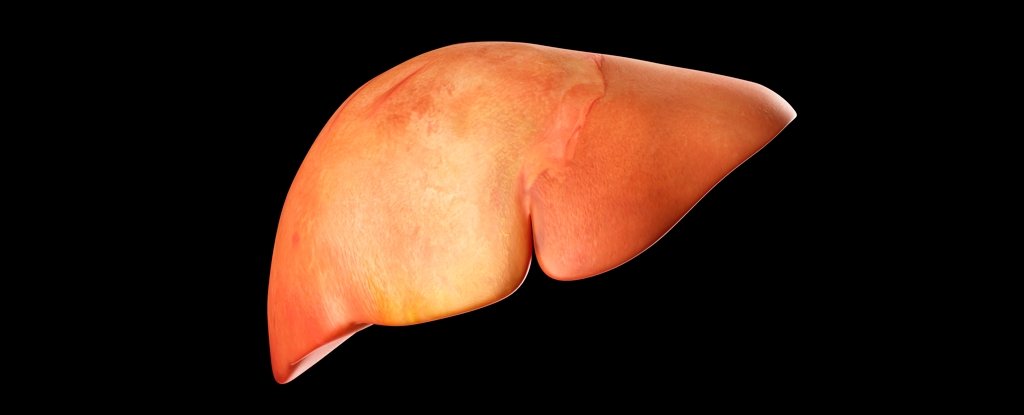
Your liver, shown at three years of age. (SciePro/Getty Images)
For the experiment, researchers led by first author and molecular biologist Zhao-Qing Shen of National Yang Ming Chiao Tung University in Taiwan examined hesperetin. This natural flavonoid, found in lemons, limes, oranges and other citrus fruits, has demonstrated potential for a variety of pharmacological effects, including anti-inflammatory, anti-ageing and neuroprotective properties.
Earlier work identified hesperetin as an activator of the longevity-linked gene CISD2 - known as Cisd2 in mice - which is understood to support metabolic and liver health.
"In the liver, Cisd2 deficiency promotes steatohepatitis [fatty liver disease] and hepatocellular carcinoma [liver cancer], whereas increased Cisd2 expression preserves youthful metabolic profiles and attenuates age-related hepatic dysfunction," the researchers explain in their paper.
"Notably, Cisd2 expression declines during aging, suggesting that restoring its expression may represent a promising strategy for delaying liver aging and preventing age-associated liver diseases."
How hesperetin affected aged mouse livers
To investigate this idea, the scientists administered a daily dose of hesperetin to naturally aged mice, 21 months old, for five months. A control group instead received an inactive substitute.
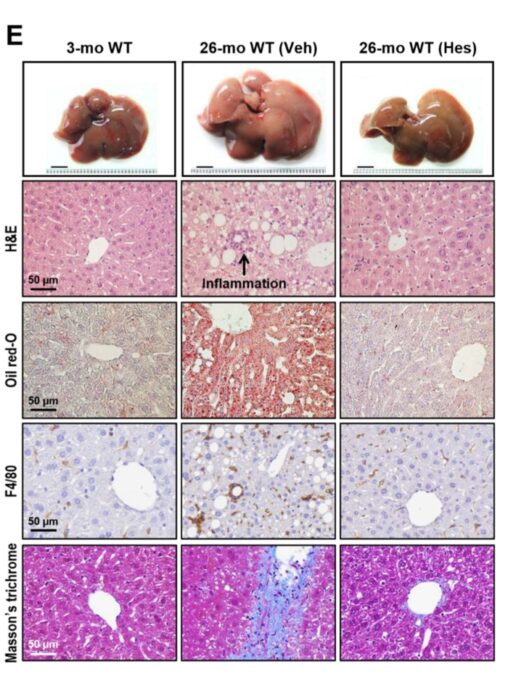
Mouse livers compared, showing young mice (three months of age, left), control mice (26 months, centre), and hesperetin mice (26 months, right). (Shen et al., *npj Aging, 2026)*
Once the treatment period ended, Cisd2 levels had fallen significantly in the livers of the control animals, which were 26 months old. However, aged mice given hesperetin each day had liver Cisd2 levels similar to those in young mice aged only three months. Other signs of liver ageing and deterioration also declined, including fat deposits, injured liver cells and inflammation.
"Collectively, these results demonstrate that hesperetin consumption alleviates hepatic pathological damage and delays liver aging in aged mice, an effect that closely correlates with the upregulation of Cisd2 expression," the researchers write.
RNA sequencing, used to compare gene activity, indicated that the citrus compound moved gene expression in treated mice towards a younger pattern. It reversed several age-related alterations in gene expression observed in control animals.
In another experiment, mice genetically modified to lack Cisd2 in the principal functional cells of their livers did not respond to hesperetin. These animals had already shown signs of impaired liver health when only three months old as a result of the missing gene.
That result backs the view that the citrus compound depends largely on Cisd2 to act in mouse liver cells, and is mostly ineffective without it, although the researchers also detected some changes independent of Cisd2.

The possible human liver pathway
The researchers say hesperetin seems to operate through a signalling pathway involving two proteins, Hmgcs2 and Pparα, which together raise Cisd2 activity.
Much more research is required to establish whether hesperetin can safely deliver comparable benefits for human liver health, but the early components of such a pathway may be present.
Related: The Clearest Evidence Yet That a Common Plastic Increases Risk of Fatty Liver Disease
The team also examined non-tumour liver samples from 80 patients who had undergone surgery for either liver cancer or benign tumours. In these human liver tissues, PPARα and CISD2 expression decreased with age.
On its own, this finding proves nothing. But it indicates that the reduced Cisd2 activity identified in mice could also occur in older people. If so, enhancing that pathway with hesperetin might perhaps help rejuvenate human livers as well.
Considering all that the liver does for us, it deserves to be investigated.
"These findings taken together, provide strong evidence for hesperetin being a potent liver anti-aging treatment and form the groundwork for future clinical interventions using hesperetin as a potent Cisd2 activator and as a functional food derived from the peels of citrus fruits," the researchers write.
"Hesperetin from citrus peel and other sources has the ability potentially to slow down liver aging (or to rejuvenate an aging liver) as well as helping to ameliorate age-associated fatty liver disease."
The findings appear in npj Aging.
This article was fact-checked and edited by Rebecca Dyer. Although we take pride in our process, we are only human. If you notice an error, please let us know.





Comments
No comments yet. Be the first to comment!
Leave a Comment