
More and more people are questioning how safe the rice they eat every day really is. Studies indicate that the grain may contain significant amounts of arsenic, a substance nobody wants to retain in their body over the long term. New research now points to a specific cooking method that can substantially lower the level without turning rice into a nutritional wasteland.
Why rice contains arsenic at all
Arsenic may sound like something from a toxicology laboratory, but it occurs naturally. It is present in rocks, enters groundwater through erosion and then makes its way into rivers, lakes and irrigation systems. This substance accumulates in the water of flooded rice paddies - and that is where the issue begins.
Unlike wheat or maize, rice is generally grown in water. The plant absorbs arsenic through its roots and deposits it in the grain. Other cereals are far less affected because they do not remain in waterlogged soil permanently.
The European Food Safety Authority (EFSA) has warned of the health risks for years. Higher intake over a long period is associated, among other things, with an increased risk of certain cancers, including skin cancer. Strict EU limits therefore apply:
- White rice: a maximum of 0.15 milligrams of arsenic per kilogram
- Brown rice (wholegrain): a maximum of 0.25 milligrams per kilogram
Manufacturers must comply with these requirements. Rice sold on supermarket shelves is therefore well below acutely toxic quantities. Even so, it is worth taking every opportunity to reduce day-to-day intake further, particularly for people who eat rice regularly.
What common online tips actually achieve
Countless “life hacks” on platforms such as TikTok claim to reduce arsenic in rice. Some users advocate thorough rinsing, while others recommend cooking it in vast quantities of water. Although this may seem convincing, it only partly stands up to scrutiny.
Rinsing rice: cleaner, but with hardly any less arsenic
Many people rinse rice carefully until the water runs clear. This removes starch, dust and some possible contaminants. However, US Food and Drug Administration (FDA) data suggest that it does little to alter the amount of arsenic inside the grain.
“Rinsing rice improves its appearance and texture, but reduces arsenic only marginally - while also washing away valuable nutrients.”
Some important vitamins and minerals are found on the surface of the grain. Vigorous rinsing sends them down the drain. People eating rice for health reasons may therefore lose part of its benefit.
Cooking in plenty of water: less arsenic, but fewer nutrients too
For people who consume a lot of rice, the FDA advises cooking it in a large volume of water: six to ten parts water to one part rice, followed by draining away the remaining water. Measurements show that:
- Arsenic in rice falls by around 40 to 60 per cent.
- At the same time, 50 to 70 per cent of certain vitamins are lost, including folate, iron, niacin and thiamine.
Regular use of this approach may lower arsenic, but it also leaves rice considerably more “empty” nutritionally. It is not an ideal trade-off for children, pregnant women or people whose nutrient intake is already limited.
The new method: parboiling followed by absorption
A research team at the University of Sheffield tested a cooking technique that has an even greater effect on arsenic while preserving nutrients more effectively. The work was published in the specialist journal “Science of the Total Environment”.
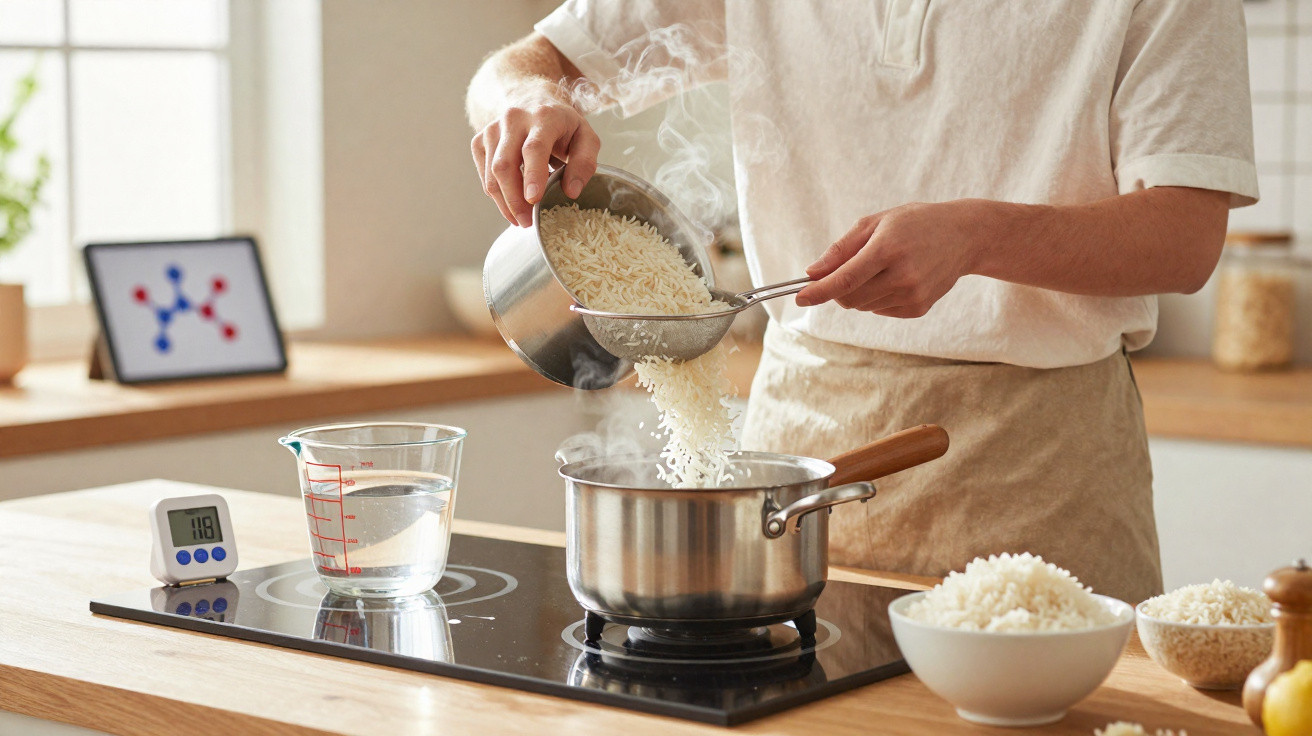
The principle is simple: briefly pre-treat the rice in vigorously boiling water, then cook it using the conventional absorption method. The researchers call the process the “parboiling-and-absorption method”.
How the 73-per-cent method works, step by step
- Measure out the rice, for example 1 cup.
- Put plenty of water in a saucepan, using at least five times the volume of rice.
- Bring the water to the boil and add the rice.
- Boil vigorously for five minutes.
- Drain all of the water and discard it.
- Add fresh water, at roughly 2 parts water to 1 part rice.
- Simmer over a medium heat until the water has been absorbed and the rice is cooked.
“With just five minutes of pre-cooking and fresh water, the arsenic content of white rice falls by an average of 73 per cent.”
The study found that arsenic levels fell by around 73 per cent in white rice and by 54 per cent in brown rice. Mineral nutrients such as zinc were largely retained at the same time. This currently makes the method the best compromise between safety and nutritional value.
Who particularly benefits from the extra effort
Anyone who only eats an occasional portion of rice does not need to panic. The method is especially relevant for groups that rely on rice frequently:
- Families serving rice several times a week
- People following a gluten-free diet who often use rice products instead
- Young children who regularly eat rice cakes or rice pudding
- Households where rice is an affordable source of calories
For these people, the new cooking technique can noticeably reduce everyday arsenic intake without requiring them to give up a favourite dish.
Which rice varieties carry a lower burden
Arsenic levels are not the same in every type of rice. They depend on the region, variety and processing method. Research repeatedly points to several broad trends:
- Basmati from certain growing regions often performs more favourably.
- Brown rice tends to contain more arsenic because the bran layer remains intact.
- Rice from areas with low-arsenic irrigation water usually has lower levels.
People who eat rice often can check origin information in shops and switch brands from time to time. Mixing different varieties helps prevent potentially high values from a single source becoming significant over the long term.
Fitting the method into everyday life
At first glance, the new cooking method may appear slightly inconvenient, but it can be incorporated into everyday routines quite easily. For example:
- During the five-minute pre-boiling stage, you can chop vegetables or prepare the pan for a stir-fry.
- For meal prep, a larger quantity of rice can be made using the parboiling-and-absorption method and stored in the fridge.
- Anyone making sushi or bowls regularly can make the technique their standard approach.
The principle can also be used with a rice cooker: briefly blanch the rice in a saucepan first, drain it, then transfer it to the rice cooker with fresh water to finish cooking.
What arsenic does in the body - and when it becomes a concern
Arsenic is mainly problematic when it is consumed gradually over a long period. The substance binds to certain proteins and disrupts cellular processes. Depending on dose and duration, it is associated with:
- Changes to skin and nails
- Higher rates of certain cancers
- Effects on the cardiovascular system
Rice products permitted in the EU are far below quantities that cause acute poisoning, yet nobody knows precisely how decades of slightly elevated exposure may affect the body. The more ways consumers have to act, the better they can reduce their personal risk.
Practical dietary strategies around rice
Anyone wishing to limit their arsenic exposure can combine several straightforward measures:
- Use the parboiling-and-absorption method with fresh water, especially when eating rice frequently.
- Do not make rice the only filling side dish; alternate it with potatoes, pasta or millet.
- For children’s snacks, do not rely solely on rice cakes; choose maize- or spelt-based alternatives too.
- For nutritional reasons, focus more on vegetable and protein accompaniments than on planning very large rice portions as the main source of fullness.
This reduces overall intake without having to remove the grain from the diet altogether. The new cooking method is one practical element that is especially easy to adopt when rice is already a regular feature of meals.






Comments
No comments yet. Be the first to comment!
Leave a Comment