
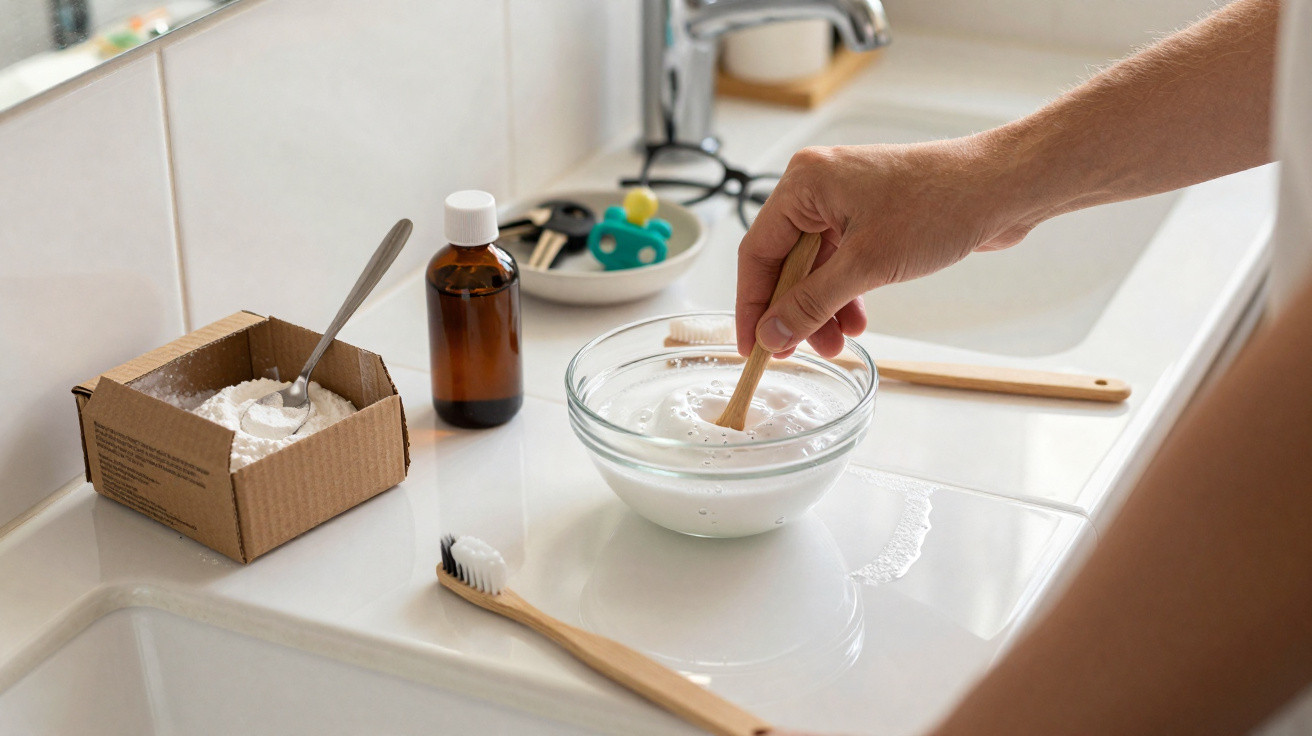
The first time I watched someone tip hydrogen peroxide into a bowl, add a spoonful of baking soda and say casually, “This fixes almost everything,” I assumed they were overstating it. The solution bubbled, became a little cloudy, and a crisp, pungent scent spread through the kitchen. On the worktop, a stained chopping board looked ready for its before-and-after photograph.
Within five minutes, the turmeric-yellow marks had nearly vanished. The mixture had worked its way into narrow grooves that had resisted even a scouring pad.
That modest kitchen experiment has since played out, almost unnoticed, in bathrooms, garages and dental practices around the globe.
This decidedly unglamorous pairing is becoming something of a secret household weapon.
The low-cost fizzing pairing experts quietly endorse
Speak to a chemist or dentist about baking soda and hydrogen peroxide, and many respond with the same knowing half-smile. This is not the latest fashionable miracle formula. It is straightforward chemistry, available for a few pounds-or less-from pharmacies and supermarkets.
Separately, both are mild but useful staples: baking soda works as a gentle abrasive and deodoriser, while hydrogen peroxide is an inexpensive disinfectant. Combine them and they become more active. The fizz is a genuine chemical reaction rather than a social-media spectacle. Oxygen is released, helping to shift dirt, destroy microbes and loosen stains.
That is precisely why an increasing number of experts discreetly suggest this combination for certain, limited uses.
Consider tooth whitening. There is a reason that so many whitening toothpastes include versions of both ingredients. A 2021 review in a dental journal noted that low levels of peroxide combined with a mild abrasive such as baking soda may reduce surface staining from coffee, wine and tobacco, without resorting to harsh at-home bleaching.
A dental hygienist in Paris told me about a situation she sees repeatedly: patients arrive carrying costly whitening kits and are already dissatisfied with the results. Instead, she will often recommend a brief, carefully managed routine involving a baking-soda paste with diluted hydrogen peroxide a couple of times weekly.
In her experience, the most striking results do not come from the most fashionable gels, but from using this ordinary-looking pair correctly and patiently.
Why baking soda and hydrogen peroxide work together
What makes it useful in so many settings? Baking soda raises the pH slightly, helping oily dirt detach from surfaces, and its fine grains provide light scrubbing action. Hydrogen peroxide supplies the oxidising effect, breaking down and releasing oxygen that acts on pigments, bacteria and certain viruses.
For cleaning, their roles are complementary, rather like a gentle sponge paired with a powerful detergent. One helps release the dirt; the other helps remove it.
This also explains why dermatologists suggest the duo for particular foot concerns, dermatology nurses use it for nail implements, and cleaning professionals recommend it for grout lines untouched by any “miracle spray”. The precise formula differs between experts, but the underlying principle is the same.
From grout lines to toothbrushes: using the mixture properly
Here is the practical approach. For cleaning around the home, a standard technique begins with sprinkling baking soda over the item itself: a sink, bath, tile grout or even the inside of a stained mug. Next, pour or spray a small quantity of 3% hydrogen peroxide over it.
The bubbling begins in seconds. At that point, leave the reaction to work for 5–10 minutes. Then scrub gently with a sponge or an old toothbrush, before rinsing with warm water.
The difference on white bathroom grout can be surprisingly dramatic. Dull grey seams can return much closer to their original white without bleach’s harsh odour.
This same simple technique can be used for chopping boards, fridge shelves, bins and some fabric marks. With fabric, dab rather than soak: apply a little baking soda paste to the mark, add a small amount of hydrogen peroxide, blot gently and then put it straight into the wash. Always try it first on an unseen area, as peroxide may lighten colours.
Oral care calls for greater care and accuracy. Many dentists advise combining a teaspoon of baking soda with only enough 3% hydrogen peroxide to make a thin paste, then brushing softly for roughly 30 seconds to 1 minute. It should not be used daily or in place of ordinary toothpaste, but once or twice weekly to manage staining.
In truth, hardly anyone follows this routine every day. Most people think of it before a major occasion, a date or a job interview-when those coffee marks suddenly seem especially important.
The pairing is particularly useful for disinfecting small items that come into daily contact with your body. This includes nail clippers, tweezers, metal nail files and even a toothbrush head. According to infection-control guidance that supports peroxide for domestic use, soaking these tools for 10 minutes in a small bowl of 3% hydrogen peroxide with a pinch of baking soda can lower their microbial load.
Naturally, the danger is becoming too confident. After seeing how effectively it cleans tiles, people may ask, “Why not my face? Why not my scalp?” This is where experts become more cautious. Your skin barrier is not a bathroom tile. Strong concentrations, prolonged exposure or everyday application can cause irritation, burns or disruption to the microbiome.
“Hydrogen peroxide is a medicine, not just a cleaning product,” warns Dr. Léa Moretti, a dermatologist in Milan. “Used occasionally, in low concentrations and rinsed off, it can help. Used aggressively, it damages the same tissues you’re trying to protect.”
- Use 3% hydrogen peroxide, not stronger (the brown bottles sold in pharmacies), unless a health professional advises otherwise.
- Keep exposure brief on teeth and skin: generally below 1–2 minutes, then rinse thoroughly.
- Never swallow the mixture, and store it out of the reach of children and pets.
- Test a small hidden area of a surface or fabric first, to prevent unexpected bleaching or damage.
- If you have sensitive gums, chronic skin conditions or respiratory issues, talk to a professional before copying internet recipes.
The understated strength of simple household chemistry
There is something reassuring about the growing popularity of this modest combination in a world preoccupied with specialist products. When every cupboard is packed with purpose-made sprays and gels, seeing baking soda and hydrogen peroxide handle task after task can feel like a quiet form of resistance.
You do not need a chemistry qualification to recognise its appeal. There is white powder from the baking shelf and clear liquid from the first-aid aisle. Together, they clean, whiten, deodorise and disinfect in ways that are visible and noticeable. There is no fluorescent branding, but there are decades of scientific knowledge behind them.
Experts are not claiming that these two ingredients can replace every product in the home. Bleach still matters for certain germs, and specialist dental care remains the gold standard in complicated cases.
Rather, they are quietly pointing out that simpler, cheaper and more understandable options may be enough for many routine jobs: a marked mug, a musty chopping board, a grout line that looks worn out, or nail tools you have been intending to clean.
As more people report their own small successes with the mixture, its standing continues to build-not as a miracle cure, but as a reliable helper. Perhaps that is what makes it feel so modern.
The next time you open the cleaning cupboard or bathroom drawer, those two everyday products may seem slightly different. You might test a tiny patch of a stubborn coffee stain, or give your toothbrush head a bubbling soak at the end of the week.
These are minor actions, nearly invisible amid the pace of daily life. Still, they subtly alter how you think about your home, your body and the boundary between medical guidance and domestic know-how.
Some of the most effective tools were never intended to look glamorous. They simply remain there, waiting for someone to pour, sprinkle and watch the bubbles appear.
| Key point | Detail | Value for the reader |
|---|---|---|
| Safe basic combination | Affordable baking soda and 3% hydrogen peroxide, used with brief contact times | Access to expert-approved cleaning and whitening without costly products |
| Broad range of uses | Tooth stains, grout, chopping boards, tools, certain fabrics and odour problems | A single duo addresses several everyday issues, saving storage space and time |
| Need for control | Follow concentration guidance, patch-test and do not overuse on teeth or skin | Gain strong results while safeguarding surfaces and health |
FAQ:
- Can I use baking soda and hydrogen peroxide on my teeth every day? Most dentists advise only occasional use-usually one to two times weekly-alongside regular fluoride toothpaste, to reduce the risk of enamel wear and gum irritation.
- Is this mixture safe for coloured fabrics? Hydrogen peroxide may lighten some dyes, so test it on an inconspicuous spot first and use the gentlest, shortest possible treatment on anything that is not white.
- Can I clean a chopping board with it and still prepare food safely? Yes, provided you use 3% hydrogen peroxide, rinse it thoroughly with plenty of water afterwards and leave the board to air-dry completely before using it.
- Does it replace bleach for disinfection? Not completely: hydrogen peroxide is effective against many microbes, but professional guidance may still favour bleach or specialist products for serious contamination or particular pathogens.
- Which surfaces should I avoid with this combination? Avoid delicate natural stone, including marble or granite, as well as unfinished wood, silk and certain leathers, because the mixture can etch, dry out or discolour these sensitive materials.






Comments
No comments yet. Be the first to comment!
Leave a Comment