
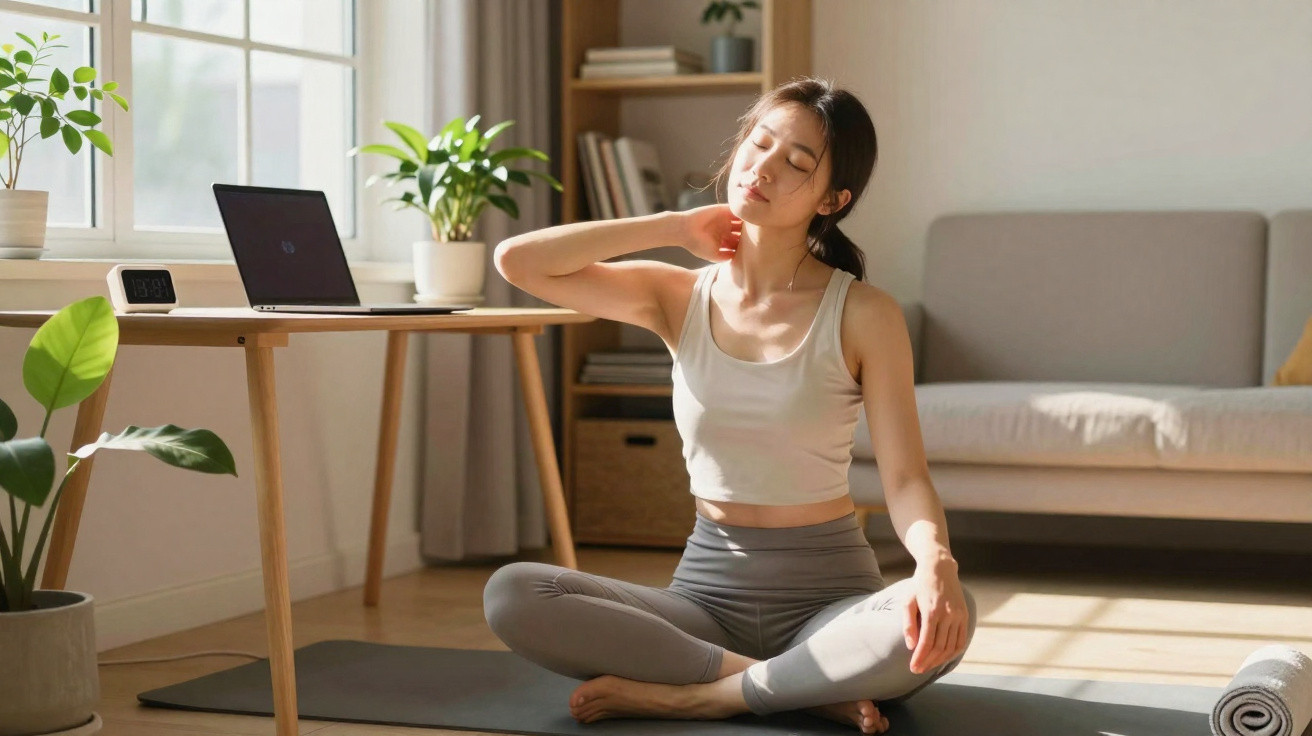
You tip your head to one side, hear a quiet crack, and the screen glares back at you. Twelve tabs are open and your neck feels as hard as concrete. You rub the spot between your neck and shoulder; it warms up for a moment, then everything feels exactly as it did before. A familiar scenario.
We all know that odd moment when your body suddenly feels like an uncomfortable office chair. You can tell something up there is tightening, yet you are not quite sure where to start. One more email. One more message. One more scroll through social media.
Then a short yoga video appears in your feed. Five minutes, “Neck Relief”, soft music. You click it with half an ironic smile – and ten minutes later, you get up with a surprisingly different feeling in your neck. Almost as though someone has opened a window. What just happened?
Why your neck is the first to protest – and how short yoga sessions help
Neck tension is like a tiny red warning light that we keep ignoring. Your body whispers, “That’s enough now,” and we postpone responding until later. The muscles tighten, your head feels heavier and movement becomes more restricted. Eventually, you notice that you can barely turn to look over your shoulder.
Short yoga sessions work precisely in that gap. They do not require lots of preparation, a perfect outfit or even much room. Five to ten minutes can be enough to offer your body a different pattern. It is not a drastic restart, but more like a quiet reset button. The magic is not in the duration, but in repeating small prompts.
One evening in a Berlin co-working space: eight people, eight laptops and a yoga mat in the corner. At about 4 pm, a woman gets up, shuts her computer and sits on the floor. Three minutes of “Cat-Cow”, a few shoulder circles and a slow twist. At first, the others look puzzled; then two colleagues join in. Ten minutes later, everyone is laughing, and someone carefully stretches their neck and says: “Wow, I can turn my head again.”
These mini-sessions now appear everywhere: in apps, on YouTube, in workplace programmes and in the waiting rooms of physiotherapy clinics. A small US study showed that as little as 8 minutes of gentle desk yoga can measurably reduce muscle tension in the neck. It is not dramatic, but clear enough for people to take fewer painkillers by the end of the day. It does not feel like a “big event”, but rather a subtle shift: a little more space between ear and shoulder, a little less pressure behind the eyes.
At a physical level, a surprising amount happens in a remarkably short time. When you breathe deliberately and move slowly for a few minutes, your nervous system receives a different signal. The sympathetic nervous system – the part responsible for alertness and performance – briefly steps back. The parasympathetic system, your rest mode, has more room. The muscles around the cervical spine can release because they no longer feel constantly under threat.
At the same time, you are working with the fascia: the delicate web of tissue surrounding muscles and organs. Prolonged sitting can cause the fascia around the neck to become genuinely stuck together. Gentle stretches, rotations and micro-movements address these adhesions. Not all at once, but layer by layer. One short flow a day can feel like one fewer knot in the system every evening.
How a 7-minute routine can genuinely relax your neck
A realistic starting point? Seven minutes, perhaps between two appointments or straight after getting up. No candles and no chanting – just you, your breath and a little space. Sit on a chair or the floor and lengthen your spine without forcing it. Take one deep breath in through your nose and out through your mouth, as if you are briefly blowing the day away.
Begin with slow head half-circles, moving from one shoulder to the other. Keep them slow, almost hesitant. Notice where the tension is loudest, and stay there for one extra breath. Move on to shoulder rolls, first backwards and then forwards. Next, clasp your hands behind your head and gently press the back of your head into your hands, without pulling your neck forwards. Take two or three breaths, then release. This small sequence takes less time than scrolling through a story.
The most common mistake is going in too hard, too fast and with too much ambition. Many of us treat our own body as a project with a deadline. “Right, today I’m going to get rid of this tension.” Then the head is suddenly pulled harshly to one side, the breath is held and the jaw tightens. The result? The body closes down and the muscles resist. A classic boomerang effect.
Gentle really does mean gentle. Only move as far as your body is willing to go, rather than as far as you “want” it to go. And yes, we all know those unrealistic plans along the lines of: “From tomorrow, I’ll do 20 minutes of yoga every morning.” Let’s be honest: nobody truly does that every day. Three to five minutes, two to three times a week, is closer to real life – and closer to a neck that no longer screams.
A woman I spoke to after a short office-yoga workshop later said:
“I always thought relaxation needed a spa weekend. Then I realised that my neck responds when I simply take one deep breath and close my laptop for three minutes.”
A few clear anchors in your day work especially well:
- After your first coffee: 3 slow head half-circles and 5 shoulder rolls
- Before your longest video call: 1 minute of deep seated belly breathing
- After work: 2 gentle seated twists, looking over your shoulder
- Before bed: 1 passive stretch, allowing your head to fall to one side
- In a traffic jam or on the train: relax your jaw, let your tongue drop from the roof of your mouth and blink consciously
What changes when you give yourself a few minutes of neck yoga each day
The more consistently you include these short sessions, the more your body recognises: “Ah, relief is coming.” Your muscles learn that their default state does not have to be “tension plus pain”. Some people report that after two weeks, they suddenly notice how often they unconsciously lift their shoulders – and then let them drop again automatically. Not because they “remember” to do it, but because the nervous system has established new standards.
It is also interesting what happens in your mind. People who loosen their neck often find that the mental fog becomes lighter. Headaches occur less often and periods of concentration become a little clearer. It is as though the range of your vision expands – physically and emotionally. Rather than staring only at the screen, your gaze can wander out of the window again. That small shift in perspective can change the tone of your entire day.
And yes, sometimes a mini-session is not enough. Chronic pain, old injuries and stressful periods of life all run deeper. Short yoga routines are not a miracle cure in these cases, but a quiet ally. They do not replace a medical assessment, yet they restore a sense that you can take action. You are no longer simply at the mercy of it all; instead, several times a day you send your body a message: “I’m paying attention to you.” Sometimes, that is exactly where real change begins.
| Key point | Detail | Benefit for the reader |
|---|---|---|
| Short sessions work quickly | Just 5–10 minutes can noticeably lower muscle tone and stress levels | A realistic, everyday starting point without a major time commitment |
| Gentle movement rather than force | Slow stretching, conscious breathing and a focus on your comfort zone | Reduces injury risk and stops the body from “closing down” |
| Build routines into your day | Small fixed anchors: before meetings, after work and before bed | A better chance of sticking with it and experiencing less neck pain in the long term |
FAQ:
- How often should I do short yoga sessions for my neck? 2–5 times per week is enough to feel the first effects. If you wish, you can also include 3–5 minutes every day.
- Can I do neck yoga directly at my desk? Yes, many exercises work while seated: gentle rotations, shoulder rolls, conscious breathing and small micro-breaks for your eyes.
- What if I feel dizzy during neck exercises? Slow down immediately, reduce the range of movement and take a break. If the dizziness persists or is severe, seek medical advice.
- Are short sessions enough for severe, chronic neck pain? They can be supportive, but they do not replace a diagnosis. If pain is persistent or worsening, a doctor, physiotherapist or osteopath should assess it.
- Do I need a mat or special equipment? No. A chair, some space around your shoulders and comfortable clothing are enough to begin with the first exercises.


Comments
No comments yet. Be the first to comment!
Leave a Comment